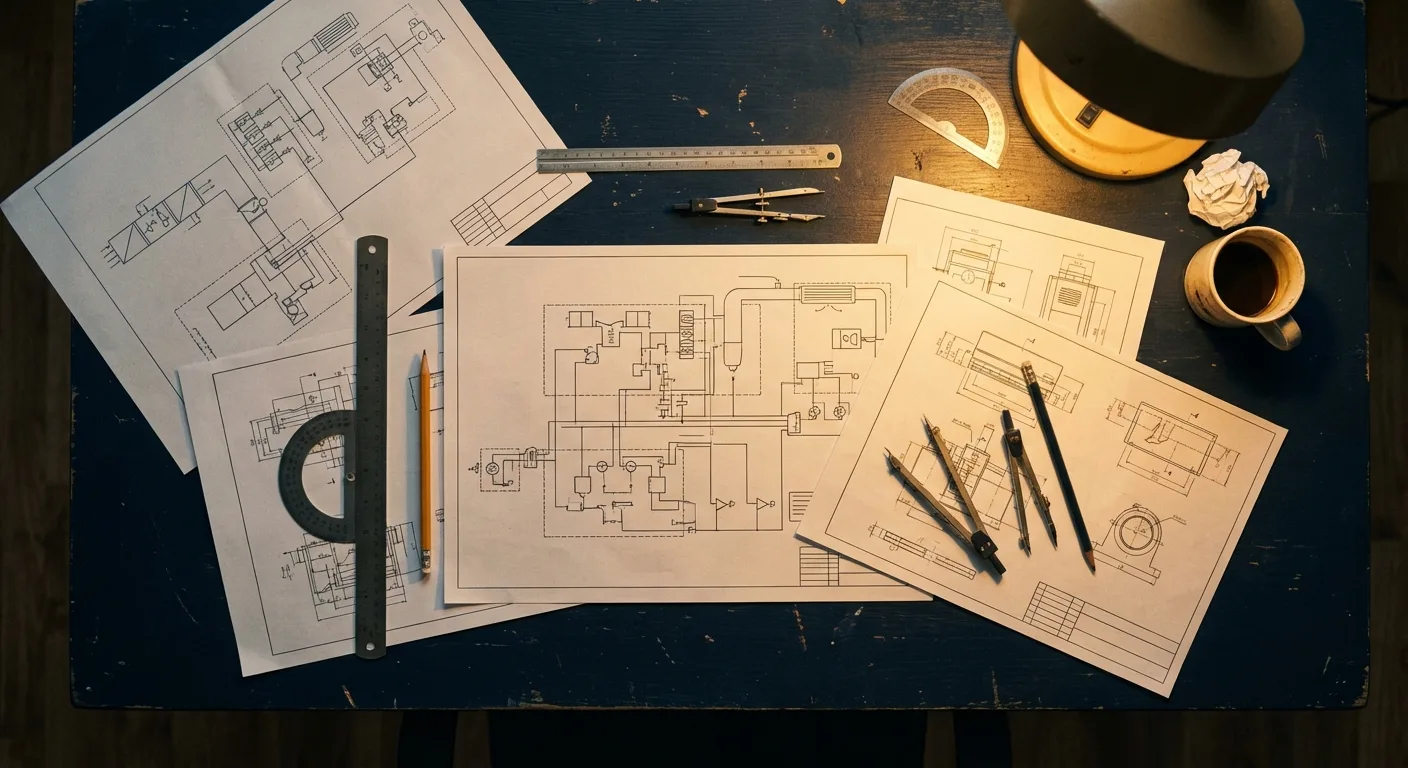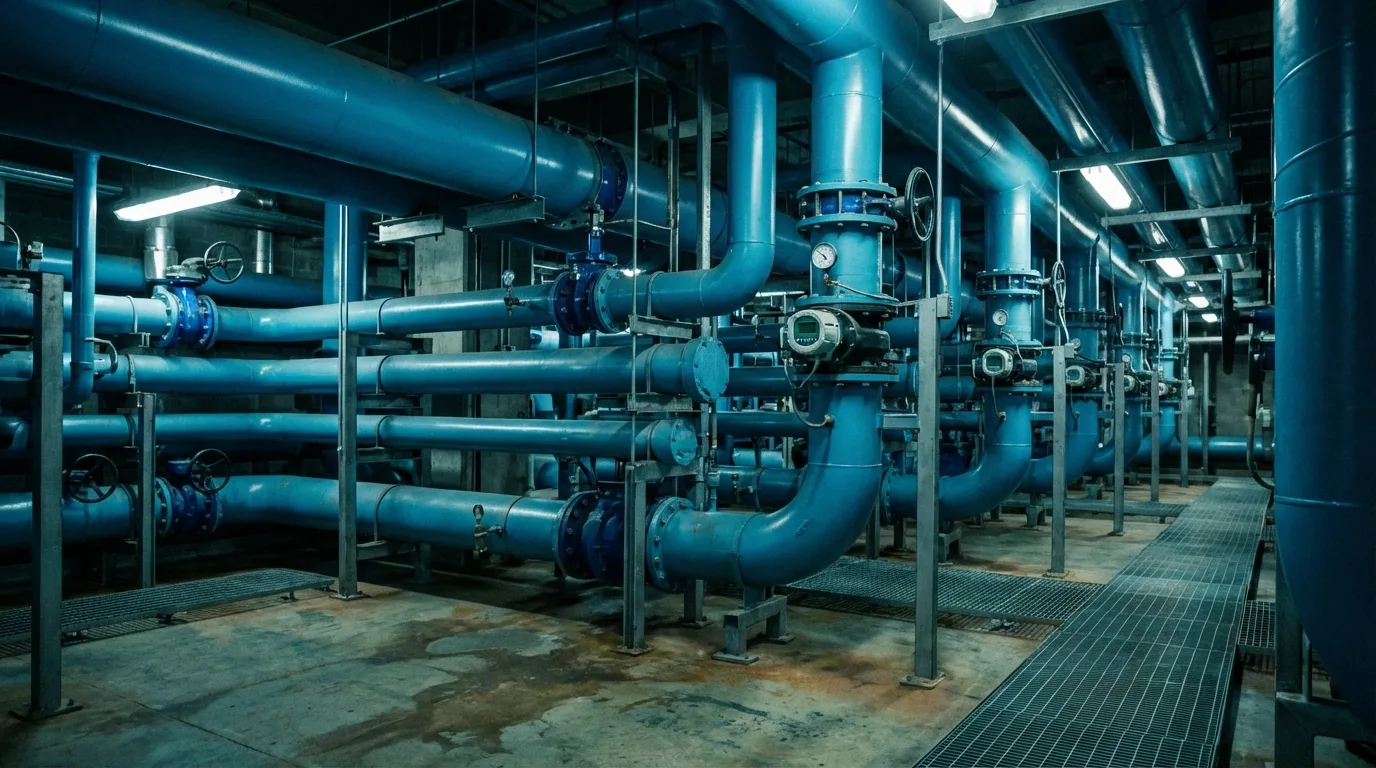
The piping system is the "arteries and veins" of HVAC engineering -- it precisely delivers the cooling capacity produced by chillers through chilled water piping to air handling units and fan coil units on each floor of a building, then returns the warmed water back to the chiller side for re-cooling. The quality of piping design directly determines the transport efficiency, pump energy consumption, water flow balance, and long-term operational reliability of the chilled water system. However, in practice, piping design is often overlooked in terms of engineering complexity because it is hidden within pipe chases and above ceilings. In fact, a poorly designed piping system can lead to uneven flow distribution, excessive pressure losses, water hammer noise, and even pipe corrosion and leaks, preventing the entire HVAC system from achieving its intended performance. This article systematically analyzes the six core aspects of HVAC piping design from an engineering practice perspective.
1. The Role of HVAC Water System Piping and Design Process Overview
The performance of an HVAC water system depends not only on the efficiency of core equipment such as chillers and cooling towers; the piping system, as the carrier for cooling and heating energy transport, is equally critical in design quality. According to ASHRAE research[1], pump transport energy in chilled water systems typically accounts for 15% to 25% of total HVAC system energy consumption, and pump energy is directly related to the pressure loss characteristics of the piping system. A poorly designed piping system -- undersized pipes, excessive elbows, improper valve layouts -- will significantly increase system pressure losses, forcing pumps to operate at higher heads and resulting in significant energy waste.
Basic Functions of Water System Piping
HVAC water system piping serves three core functions: First, it delivers low-temperature chilled water produced by the chiller (supply water temperature typically 7°C) to each HVAC terminal device (AHU, FCU, etc.), where the chilled water absorbs indoor heat through coils; second, it collects and returns the warmed chilled water (return water temperature typically 12°C) back to the chiller for re-cooling, completing the closed-loop cycle; third, on the condenser water side, it delivers high-temperature condenser water discharged from the chiller condenser to cooling towers for heat rejection, then returns the cooled condenser water to the condenser. In large commercial buildings or industrial facilities, the total length of piping systems can reach several kilometers, with pipe sizes ranging from DN15 to DN600, requiring a level of systematic precision and accuracy comparable to structural engineering design.
Overall Piping Design Process
A complete piping design process includes: determining required water flow rates for each loop based on HVAC load calculations, selecting pipe materials and joining methods, calculating pipe sizes based on design methods, performing hydraulic calculations and system pressure loss analysis, planning expansion tanks and water treatment systems, confirming pipe support and insulation requirements, and developing construction quality control plans. Each step is interconnected, and any oversight at one point can cause overall system performance to deviate from design targets. ASME B31.9[2], as the design code for building services piping, provides fundamental engineering guidelines for piping system pressure ratings, material selection, and joining methods.
2. Pipe Material Selection: Carbon Steel, Copper, and Stainless Steel Comparison
Pipe material selection is the first critical decision in piping design, affecting subsequent pipe sizing calculations, pressure loss characteristics, joining and construction methods, service life, and project costs.
Carbon Steel Pipe
Carbon steel pipe is the most mainstream pipe material for HVAC chilled water and condenser water systems, particularly in pipe sizes DN50 (2 inches) and above. Seamless or electric-welded steel pipes manufactured per ASTM A53/A106 specifications[3] offer excellent mechanical strength, pressure resistance, and cost-effectiveness. Carbon steel pipe wall thickness is graded by Schedule number, with HVAC systems commonly using Schedule 40 (standard wall), while high-pressure refrigerant piping may use Schedule 80. The main disadvantage of carbon steel pipe is susceptibility to corrosion, requiring water treatment procedures (such as chemical inhibitors and deaeration) and external anti-corrosion coatings to ensure the designed service life. Joining methods are primarily welding (DN50 and above) and threaded connections (below DN50), with flanged connections at valve and equipment connection points for ease of disassembly and maintenance.
Copper Tube
Copper tube is primarily used in HVAC systems for small-diameter chilled water branch piping (below DN50) and refrigerant piping. Per ASTM B88 specifications, copper tubes are classified as Type K (thick wall), Type L (medium wall), and Type M (thin wall)[4], with HVAC chilled water systems typically using Type L. The advantages of copper tube include excellent corrosion resistance (under neutral water conditions), smooth inner wall surface (low friction coefficient, low pressure loss), and reliable brazing joint quality. However, copper tube material costs are far higher than carbon steel, and it is not economical for large-diameter applications. Additionally, copper pipe systems must avoid direct contact with carbon steel to prevent galvanic corrosion -- when two dissimilar metals contact in an electrolyte (water), the metal with lower electrical potential will corrode at an accelerated rate. In practice, dielectric unions must be installed at copper-steel joints[5].
Stainless Steel Pipe
Stainless steel pipe (typically SUS 304 or SUS 316) offers the best corrosion resistance and longest service life, suitable for applications with strict water quality requirements or harsh corrosive environments, such as hospital purified water systems, semiconductor fab ultra-pure water systems, or coastal cooling water systems. SUS 316 contains molybdenum, providing superior chloride ion corrosion resistance compared to SUS 304, suitable for cooling tower makeup water with higher salt content. The disadvantage of stainless steel pipe is the highest material cost (approximately 4 to 6 times that of carbon steel), and welding requires argon gas shielding to prevent weld oxidation, with higher construction skill requirements. In recent years, thin-wall stainless steel pipe with press-fit connections has become increasingly popular, significantly reducing construction time[2].
Engineering Decisions for Pipe Material Selection
Pipe material selection must comprehensively consider system pressure ratings, water quality conditions, installation environment (indoor/outdoor/buried), design life, construction conditions, and project budget. In typical HVAC projects in Taiwan, the most common configuration is: carbon steel pipe for chilled water and condenser water mains, copper tube for chilled water branches (DN40 and below), and PVC pipe for condensate drain lines. For building owners with sufficient budgets seeking long-term reliability, stainless steel pipe provides the best life-cycle value.
3. Pipe Sizing Methods: Velocity Method and Pressure Drop Method
Pipe sizing is the core step of the piping design process. Oversized pipes waste materials and space, while undersized pipes cause excessive flow velocity, excessive pressure losses, noise, and erosion issues. ASHRAE Handbook -- HVAC Systems and Equipment[1] presents two fundamental pipe sizing methods.
Velocity Method
The velocity method is the most intuitive pipe sizing approach, with the basic principle of: calculating the minimum required pipe cross-sectional area based on design flow rate and maximum allowable velocity, then selecting a standard pipe size. ASHRAE-recommended design velocity ranges for chilled water piping[6] are as follows:
- Pipe size below DN50: Velocity not exceeding 1.2 m/s to control noise and pipe wall erosion
- Pipe size DN50 to DN100: Velocity 1.2 to 2.0 m/s
- Pipe size DN100 to DN300: Velocity 1.5 to 3.0 m/s
- Pipe size above DN300: Velocity up to 3.0 to 4.5 m/s (water hammer risk must be evaluated)
The velocity upper limit is set based on three primary considerations: First, noise control -- excessive water velocity generates turbulent noise at pipe walls, valves, and elbows, particularly in noise-sensitive spaces such as residential and office areas where piping noise is a common complaint; second, erosion prevention -- high-velocity water flow erosion on pipe walls shortens pipe service life, especially at elbows and tees where direction changes occur; third, water hammer suppression -- water hammer pressure waves generated by rapid valve opening/closing are proportional to velocity, with excessive velocity intensifying water hammer effects. The advantage of the velocity method is straightforward and quick calculation; the disadvantage is inability to directly control total system pressure loss.
Want to quickly calculate pipe sizing? Use our online pipe sizing calculator -- simply input flow rate and pipe material to get recommended pipe size and velocity.
Pressure Drop Method
The pressure drop method, also known as the "Equal Friction Method," is based on the design concept of: maintaining the friction pressure loss per unit length (Pa/m or kPa/100m) within a set value for every pipe section in the system. ASHRAE recommends a general design pressure loss rate of 200 to 400 Pa/m (i.e., 2 to 4 kPa/100m), with specific values depending on system scale and available pump head[1]. After setting the design pressure loss rate, combining with the design flow rate for each pipe section, the required pipe size can be determined from pressure loss charts or calculation formulas.
The advantage of the pressure drop method is its ability to simultaneously ensure reasonable velocity and pressure loss, suitable for large and complex piping systems. In practical design, engineers typically apply both the velocity method and pressure drop method for cross-verification -- first selecting pipe size using the pressure drop method, then checking with the velocity method to ensure each section's velocity falls within the allowable range. If any section's velocity exceeds the upper limit, the pipe size must be increased; if velocity is too low (below 0.6 m/s), air bubbles cannot be carried and expelled by the water flow, potentially causing air lock issues[7].
4. Hydraulic Calculations and Pipe Pressure Loss Analysis
Hydraulic calculation is the most critical quantitative analysis step in piping design, directly determining pump selection head and operating energy consumption. Total piping system pressure loss consists of straight pipe friction losses and local (fitting) losses.
Darcy-Weisbach Equation
The Darcy-Weisbach equation is the fundamental formula for pipe friction pressure loss calculation[8], applicable to all fluids and pipe materials:
ΔPf = f × (L/D) × (ρV²/2)
Where f is the Darcy friction factor (dimensionless), L is pipe length (m), D is pipe inner diameter (m), ρ is water density (kg/m³), and V is average flow velocity (m/s). The Darcy friction factor f is determined by the Reynolds number Re and relative pipe wall roughness ε/D, and in the turbulent region (Re > 4,000, which applies to virtually all HVAC water systems) must be solved implicitly through the Colebrook-White equation:
1/√f = -2.0 × log₁₀(ε/3.7D + 2.51/Re√f)
Absolute roughness ε values for various pipe materials: carbon steel pipe approximately 0.046 mm (new) to 0.3 mm (after years of use), copper tube approximately 0.0015 mm, stainless steel pipe approximately 0.015 mm, PVC pipe approximately 0.0015 mm[1]. Carbon steel pipe roughness increases with service years (due to rust and scale deposits), so design calculations should use aged roughness values to ensure the system maintains adequate transport capacity throughout its design life.
Hazen-Williams Formula
The Hazen-Williams formula is an empirical formula widely used in hydraulic engineering[9], extensively adopted in HVAC piping design due to its calculation simplicity:
V = 0.849 × CHW × Rh0.63 × S0.54
Where CHW is the Hazen-Williams roughness coefficient, Rh is the hydraulic radius (m), and S is the hydraulic gradient (m/m). Common pipe material CHW values: new carbon steel pipe approximately 130 to 140, aged carbon steel pipe approximately 100 to 120, copper tube approximately 140 to 150, stainless steel pipe approximately 140, PVC pipe approximately 150. The Hazen-Williams formula is limited to normal temperature water (4°C to 25°C) in turbulent flow through circular pipes; beyond this range, the Darcy-Weisbach equation should be used instead.
Fitting Loss
Local (fitting) losses occur at various fittings in the piping system -- elbows, tees, reducers, valves, and strainers. Fitting loss calculations typically use the equivalent length method or the K-factor (loss coefficient) method[1]. The equivalent length method converts each fitting's local pressure loss into an equivalent straight pipe length added to the total pipe length for combined calculation; the K-factor method calculates loss by multiplying the K value by the velocity pressure (ρV²/2). Common fitting equivalent lengths: 90° standard elbow approximately 30 pipe diameters, 45° elbow approximately 16 pipe diameters, fully open gate valve approximately 8 pipe diameters, fully open butterfly valve approximately 40 pipe diameters. In mechanical rooms with dense turns and numerous valves, fitting losses may account for 50% to 60% of total system pressure loss, making them a critical design focus.
Total System Pressure Loss and Pump Selection
The design total pressure loss of a chilled water piping system equals the sum of all pressure losses from the pump outlet through the index run (most unfavorable path) -- through the chiller evaporator, the farthest terminal coil, all straight pipe sections and fittings -- back to the pump inlet. The pump design head must be greater than or equal to this total pressure loss, with a safety margin of 10% to 15%[10]. For a central chilled water system serving a 5,000 m² commercial building, the design total pressure loss of the chilled water piping system typically ranges from 150 to 350 kPa (approximately 15 to 35 mH₂O). Since pump power is proportional to the product of head and flow rate, reducing piping pressure losses is the most direct path to HVAC water system energy savings.
Need to verify pipe sizing and pressure loss calculations? Try our pipe pressure loss calculator to quickly compare pressure losses and velocities across different pipe sizes.
5. Chilled Water System Piping Design Essentials
Chilled water system piping design involves several special design considerations beyond pipe sizing and pressure loss calculations that are crucial for stable system operation, including supply/return water temperature differential design, expansion tank configuration, water treatment, and system air removal.
Supply/Return Water Temperature Differential Design
The traditional chilled water system supply/return temperature differential (ΔT) design is 5°C (supply 7°C / return 12°C), but in recent years, large ΔT design (ΔT = 6°C to 8°C) has become a trend[6]. The core benefit of increasing the temperature differential is: reducing chilled water flow rate for the same cooling capacity, thereby reducing pipe sizes and lowering pump power and energy consumption. For a 1,000-ton system, increasing ΔT from 5°C to 7°C can reduce chilled water flow by approximately 29%, with corresponding pump power reduction. However, large ΔT design directly impacts terminal coil selection -- at the same cooling capacity, higher return water temperature means reduced coil average temperature differential, requiring larger coil face areas or more rows to compensate. Designers must balance piping system energy savings with terminal coil costs.
Expansion Tank Design
Water temperature in a chilled water system varies between 7°C and 35°C (from shutdown to operating state), causing water volume to expand or contract with temperature changes. The expansion tank absorbs these volume changes, maintaining system pressure within safe limits. Expansion tanks are classified as open-type and closed-type[7]: open tanks are installed at the system's highest point, structurally simple but susceptible to water contamination and air entrainment; closed expansion tanks (diaphragm or bladder type) offer flexible installation locations and are the mainstream choice for modern HVAC systems. Expansion tank volume calculations must consider total system water volume, temperature variation range, and pre-charge pressure, with ASHRAE Handbook[1] providing detailed calculation procedures. The expansion tank installation location should be at the pump suction side, which serves as the system's "point of no pressure change," ensuring all system locations maintain positive pressure during pump operation to prevent negative pressure and air ingestion at piping high points.
Water Treatment
Water treatment is a critical element for ensuring long-term stable piping system operation. HVAC water systems face four major water quality challenges: corrosion, scale formation, biological growth, and fouling[5]. Chilled water systems are closed loops with minimal makeup water, making water quality issues relatively controllable, with primary measures including: using softened or deionized water for initial system fill, adding corrosion inhibitors (such as molybdate or nitrite), maintaining water pH between 8.0 and 10.0, and installing side-stream filters to remove suspended solids. Condenser water systems are open loops where evaporative concentration effects make water quality issues more severe, requiring periodic blowdown combined with automatic chemical feed systems. Condenser water cycles of concentration are typically controlled at 3 to 5 times, balancing water quality control with water conservation.
System Air Removal Design
Air in the piping system is the enemy of chilled water system operation -- air bubbles reduce coil heat transfer efficiency, cause piping noise (bubble noise), increase system pressure losses, and promote pipe wall oxidation corrosion. Comprehensive air removal design includes: installing automatic air vents at all piping system high points, installing air separators or micro-bubble air separators at the chiller return water side, maintaining proper piping slope (generally 1/200 to 1/100 upward slope toward air vent points), and avoiding inverted U-shaped air traps[7]. The air removal procedure after initial system fill is particularly important, with vents opened floor by floor and section by section until only water is discharged.
6. Pipe Support, Insulation, and Construction Quality Control
Piping system support, insulation, and construction quality are critical to long-term operational reliability and energy efficiency, with clear technical requirements in engineering codes.
Pipe Support and Hanger Design
Pipe support design must consider pipe dead weight (including water weight), thermal expansion and contraction displacement, seismic forces, and water hammer impact loads. SMACNA[11] and MSS SP-58[12] specify maximum hanger spacing for pipes: DN25 carbon steel pipe hanger spacing not exceeding 2.1 m, DN50 not exceeding 2.4 m, DN100 not exceeding 3.7 m, and DN200 and above not exceeding 4.9 m. Thermal expansion and contraction is a factor that cannot be ignored in support design -- carbon steel pipe with a 30°C temperature change expands approximately 3.6 mm per 10 m of pipe length. Longer straight pipe runs require expansion loops, expansion joints, or natural pipe bends to absorb thermal displacement. Alternating placement of anchors and slide supports guides the direction of thermal displacement, preventing stress concentration.
Pipe Insulation Design
Chilled water pipe insulation serves two simultaneous functions: reducing cooling loss to save energy and preventing pipe wall condensation to protect building finishes. The mainstream insulation material is closed-cell elastomeric foam (such as Armaflex-type products), offering both low thermal conductivity (λ ≈ 0.035 W/m·K) and excellent moisture resistance. Insulation thickness is calculated based on pipe size, inside/outside temperature differential, and ambient dew point temperature[10]. Under Taiwan's summer conditions (ambient temperature 32°C, relative humidity 75%, dew point approximately 27°C), chilled water supply pipe (7°C) insulation thickness typically requires 25 to 50 mm (depending on pipe size). Insulation layer joints and ends must be completely sealed with specialized adhesive; any gap becomes a pathway for water vapor permeation, condensing inside the insulation layer and degrading insulation effectiveness, potentially leading to insulation deterioration and detachment in severe cases.
Condenser water piping running outdoors or in non-conditioned spaces also requires insulation to prevent winter freezing (though less common in southern Taiwan) and to reduce heat gain. Condensate drain pipes running through ceiling spaces of conditioned areas similarly need insulation to prevent pipe wall condensation dripping. Insulation work at valves, flanges, and fittings with irregular shapes is a quality control focus -- these locations are most prone to insulation gaps, creating "thermal bridge" effects.
Construction Quality Control
Piping system construction quality directly affects long-term operational reliability. Key quality control points include:
- Welding quality: Carbon steel pipe butt welding must be performed by welders holding valid certifications, with welds requiring full penetration, free of porosity and cracks. Critical pipe sections (such as high-pressure piping, buried piping) require non-destructive testing (NDT) such as radiographic or ultrasonic inspection
- Hydrostatic testing: After piping system completion, hydrostatic testing must be performed at a test pressure typically 1.5 times the design working pressure, held for no less than 2 hours, with pressure drop not exceeding 0.5%[2]
- Piping flushing: After passing the hydrostatic test, piping must be flushed with high-velocity clean water to remove welding slag, metal filings, sand, and other debris remaining from construction, preventing these contaminants from damaging pump impellers, clogging coils, or accelerating pipe wall corrosion
- Flow balancing: After system fill and operation, flow measurement and adjustment of each loop must be performed using ultrasonic flow meters or balancing valves to ensure actual flow rates in each branch pipe match design values. Flow deviation is generally required to be within ±10% of the design value
Conclusion
Piping design is a professional discipline within HVAC water system engineering that combines both theoretical depth and practical challenges. From the fundamental decisions of pipe material selection and pipe sizing, to precise hydraulic analysis using Darcy-Weisbach and Hazen-Williams formulas; from chilled water system supply/return temperature differential design, expansion tank configuration, and water treatment, to comprehensive management of pipe support, insulation, and construction quality -- every element requires solid fluid mechanics knowledge and extensive engineering experience. A well-designed piping system not only ensures stable and efficient chilled water transport but also serves as a crucial safeguard for long-term HVAC system energy savings and reduced maintenance costs. In the era of pursuing net-zero carbon emissions, reducing pump energy consumption through large temperature differential design, variable flow control, and low-pressure-loss pipe layouts has become an unavoidable core topic in HVAC piping design.