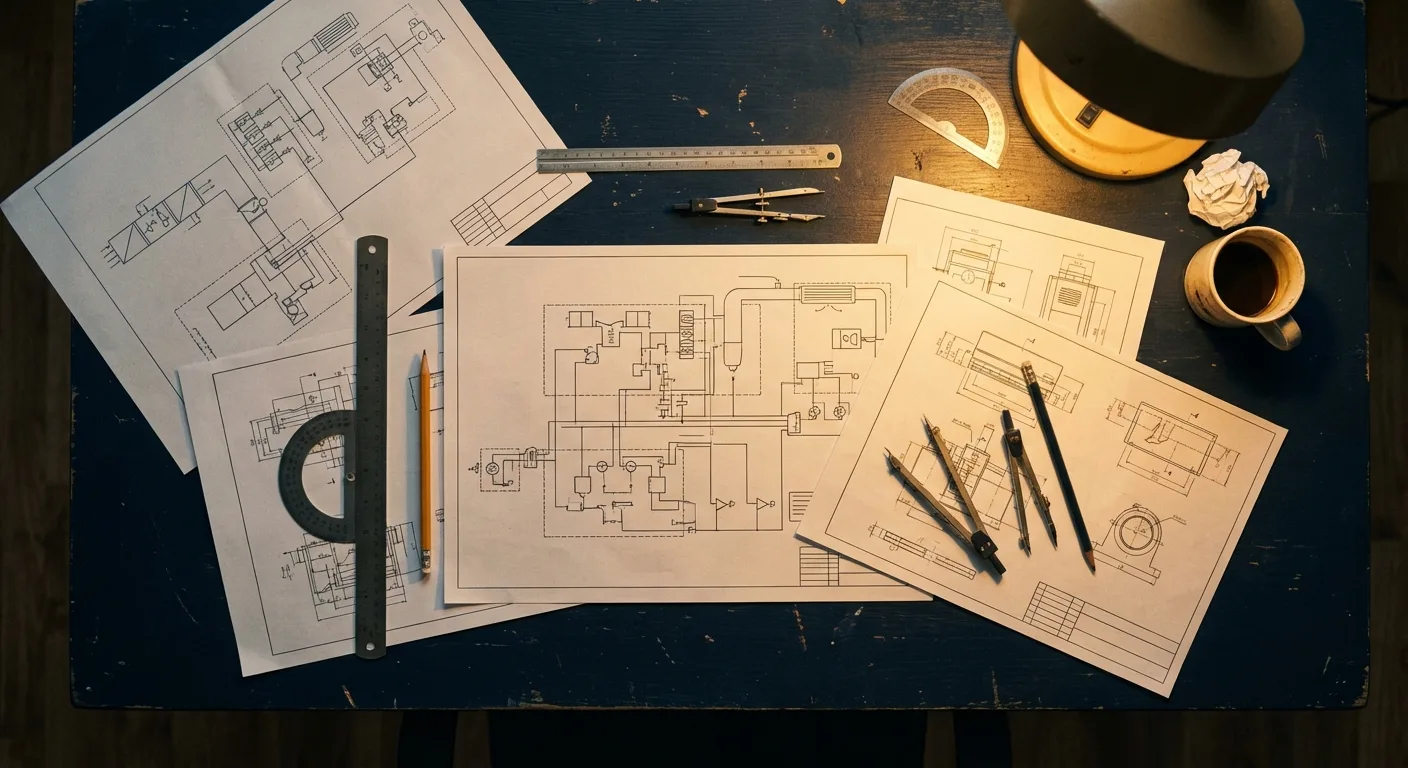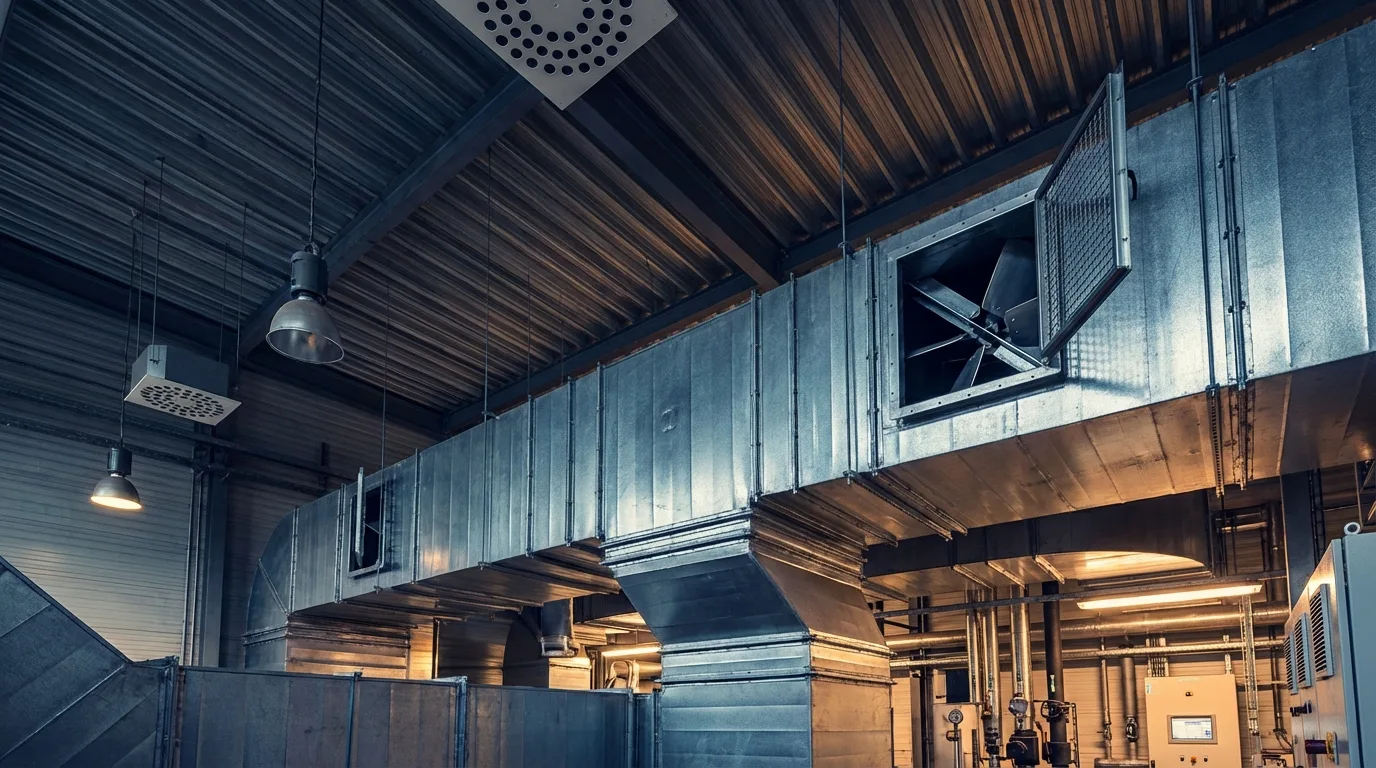
The duct system is the "vascular network" of HVAC engineering -- it precisely delivers conditioned air processed by air handling units to every corner of a building. The quality of duct design directly determines the air delivery efficiency, energy consumption, operating noise, and indoor comfort of an HVAC system. However, in practice, duct design is often underestimated in complexity because it is hidden above the ceiling. In reality, a poorly designed duct system can lead to uneven airflow distribution, excessive pressure losses, disturbing noise, and even render the entire HVAC system unable to achieve its intended performance. This article systematically analyzes the six core aspects of HVAC duct design from an engineering practice perspective.
1. The Critical Role of Duct Systems in HVAC Engineering
The performance of an HVAC system depends not only on the efficiency of core equipment such as chillers and air handling units -- the duct system, as the carrier for air delivery, is equally crucial in design quality. According to ASHRAE research[1], the pressure loss of the duct system typically accounts for 60% to 80% of the air handling unit fan total pressure, meaning that duct design directly impacts the fan motor sizing power and annual operating electricity costs.
Basic Functions of Duct Systems
A duct system serves three core functions: first, delivering temperature- and humidity-conditioned supply air to the diffusers in each HVAC zone; second, collecting indoor return air and directing it back to the air handling unit for reprocessing; and third, introducing outdoor air or exhausting stale air when needed to maintain indoor air quality and positive or negative pressure control. In large commercial buildings or industrial facilities, the total length of the duct system can reach several kilometers with hundreds of branches, and the systematic and precision requirements of its design are no less demanding than structural building design.
Overall Duct Design Process
A complete duct design process includes: HVAC load calculations to determine the required airflow for each zone, selection of duct type and material, calculating duct sizes according to the design method, performing pressure loss calculations and system balancing, evaluating noise and planning silencing measures, and confirming insulation and fire protection requirements. Each step is interconnected, and any oversight at one point can cause overall system performance to deviate from design targets.
2. Duct Types and Material Selection
The cross-sectional shape and material selection of ducts is the first critical decision in the design process, as it will affect subsequent sizing calculations, pressure loss characteristics, noise performance, and construction costs.
Cross-Sectional Shapes: Rectangular, Round, and Flat Oval
Rectangular ducts are the most common type in the Taiwan market. Their advantages include ease of fabrication, compatibility with building structures (especially when ceiling space is limited), and the ability to adjust aspect ratios to accommodate various spatial constraints. However, the SMACNA (Sheet Metal and Air Conditioning Contractors' National Association) design manual[2] notes that rectangular ducts have lower hydraulic efficiency than round ducts -- at the same cross-sectional area, rectangular ducts have 20% to 40% higher friction pressure losses than round ducts due to the boundary layer effects at the four corners. Additionally, the aspect ratio of rectangular ducts should not exceed 4:1; beyond this ratio, pressure losses increase dramatically and airflow distribution becomes uneven.
Round ducts are aerodynamically superior: for the same cross-sectional area, they have the shortest perimeter (meaning the least material usage), the lowest friction pressure losses, the highest structural strength (able to withstand higher positive and negative pressures), and the most uniform airflow distribution. In European and American markets, spiral round ducts have become the mainstream choice. Flat oval ducts combine the fluid dynamics advantages of round ducts with the spatial adaptability of rectangular ducts, making them suitable for applications where ceiling height is limited but low pressure loss is still desired.
Duct Materials
Galvanized steel sheet is the most mainstream material for HVAC ducts. According to SMACNA standards[2], duct sheet metal thickness depends on duct size and design pressure class, with low-pressure systems (static pressure within +/-500 Pa) typically using 0.6 mm to 1.2 mm thick rectangular duct sheets. Stainless steel ducts are suitable for highly corrosive environments (such as kitchen exhaust, chemical laboratories) or high-hygiene locations (such as hospital operating rooms, cleanrooms). Aluminum alloy ducts are lightweight and corrosion-resistant but more expensive, commonly used in renovation projects that require reduced structural loading.
Fiberglass duct board has dual functions of built-in insulation and sound absorption, offering advantages in low-velocity, low-pressure return air systems or terminal branch ducts. However, fiber release issues must be considered, making them unsuitable for hospitals or locations with high air quality requirements[3]. Flexible duct should only be used for short-distance terminal connections (generally not exceeding 1.8 meters), as excessively long flexible ducts cause extremely high friction pressure losses due to their corrugated inner walls.
3. Duct Sizing Calculations: Three Core Design Methods
Duct sizing selection is the core step of the entire design process. ASHRAE Handbook -- Fundamentals[1] presents three classic duct sizing calculation methods, each with its applicable scenarios and characteristics.
Equal Friction Method
The equal friction method is the most widely used design method in practice. Its basic principle is to maintain a constant friction pressure loss per unit length (Pa/m) for every section of ductwork in the system. The designer first selects a design friction loss rate -- for typical commercial building low-velocity duct systems, the typical value is 0.8 to 1.2 Pa/m[4]; for industrial high-velocity duct systems, this can be relaxed to 2.0 to 4.0 Pa/m.
After determining the design friction loss rate, the required duct diameter (for round ducts) or equivalent diameter (for rectangular ducts) can be back-calculated from ASHRAE friction loss charts or formulas combined with the design airflow for each duct section. The advantages of the equal friction method are intuitive calculations and naturally balanced pressure losses across branch ducts; the disadvantage is that it cannot guarantee identical pressures at all diffusers, and large systems still require airflow balancing adjustments.
Duct sizing calculations are based on the Darcy-Weisbach equation and the Colebrook formula. For round ducts, the pressure loss can be expressed as:
ΔPf = f × (L/D) × (ρV²/2)
Where f is the friction factor (determined by the Reynolds number Re and relative wall roughness ε/D), L is the duct length, D is the duct diameter, ρ is the air density, and V is the average air velocity. The absolute roughness ε for galvanized steel sheet ducts is typically taken as 0.09 mm[5].
Want to quickly calculate duct sizes? Use our online duct sizing calculator, just input airflow and design pressure loss rate to get recommended duct diameters.
Velocity Reduction Method
The velocity reduction method, or more precisely the "velocity reduction method," has a design philosophy that starts from the system starting point (fan outlet) and progressively reduces air velocity along the duct path as airflow decreases. The initial velocity of the main duct depends on the system type: 7.5 to 12.5 m/s for low-velocity systems, and up to 15 to 25 m/s for high-velocity systems[1]. After each branch, the main duct velocity is proportionally reduced.
The advantage of the velocity reduction method is that it allows precise control of air velocity in each duct section, avoiding noise issues from excessively high velocities (generally, indoor branch duct velocities should not exceed 5 to 6 m/s). However, this method cannot guarantee pressure loss balance in the system and usually requires volume dampers for post-installation balancing. The velocity reduction method is suitable for noise-sensitive locations such as recording studios, libraries, or premium offices.
Static Pressure Regain Method
The static pressure regain method is the most theoretically precise duct design method. Its principle is based on the Bernoulli equation[6]: when the duct cross-sectional area expands and air velocity decreases, a portion of the velocity pressure converts back to static pressure. The design goal of the static pressure regain method is: after each branch point, by appropriately enlarging the downstream main duct, the static pressure regain exactly compensates for the friction pressure loss of that duct section, thereby maintaining approximately equal static pressure at each branch point.
The greatest advantage of the static pressure regain method is that the static pressure at each branch diffuser is naturally balanced, theoretically requiring no volume dampers to achieve uniform air delivery. However, in practice, since the static pressure recovery factor is typically only 50% to 75%[1], and the diverging duct angle must be controlled within 15 degrees to avoid flow separation, practical applications still require adjustment margins. The static pressure regain method is particularly suitable for high-velocity duct systems and large HVAC systems with predominantly long straight duct runs.
4. Duct Pressure Loss Calculation and System Balancing
Pressure loss calculation is the most critical quantitative analysis step in duct design, directly determining the air handling unit fan selection pressure and operating energy consumption. The total pressure loss of a duct system consists of friction losses and dynamic losses.
Friction Loss
Friction loss occurs from the friction between air and the duct inner wall surface, with its magnitude depending on air velocity, duct diameter, duct length, and wall roughness. ASHRAE Handbook -- Fundamentals[5] provides detailed friction loss charts and calculation formulas. Under standard air conditions (20°C, 101.325 kPa, density 1.204 kg/m³), a round galvanized steel duct with an inner diameter of 400 mm delivering air at 8 m/s has a friction pressure loss of approximately 1.5 Pa/m.
Pressure loss calculations for rectangular ducts require first converting the rectangular cross-section to an equivalent circular diameter. The ASHRAE-defined equal friction equivalent diameter formula is:
De = 1.30 × (a × b)0.625 / (a + b)0.25
Where a and b are the width and height of the rectangular duct (mm), respectively. This formula ensures that a rectangular duct at the same airflow has the same friction pressure loss rate as a round duct of the equivalent diameter.
Dynamic Loss / Fitting Loss
Dynamic losses occur at various fittings in the duct system -- elbows, tees, transitions, dampers, and diffusers. Dynamic losses are typically expressed using a loss coefficient C[7]:
ΔPd = C × (ρV²/2)
Where C is a dimensionless loss coefficient whose value varies with the geometric shape of the fitting. Taking the most common rectangular 90-degree elbow as an example: a sharp-angle elbow without turning vanes has a C value of approximately 1.2 to 1.5; adding a single turning vane reduces it to 0.4 to 0.5; adding double turning vanes can further reduce it to 0.2 to 0.3. A radiused elbow (R/D >= 1.5) has a C value of only 0.15 to 0.20, making it the lowest pressure loss elbow configuration. In densely routed ceiling duct systems, the dynamic losses from elbows often exceed the friction losses of straight duct sections, making them a key focus area during design.
Total System Pressure Loss and Fan Selection
The design total pressure loss of the duct system equals the sum of all friction losses and dynamic losses along the "index run" -- the most unfavorable path from the fan outlet to the farthest diffuser. The air handling unit fan design static pressure must be greater than or equal to this total pressure loss, with a 10% to 15% safety margin. For a central HVAC system serving a 3,000 m² office space, the design total pressure loss of the duct system is typically between 300 and 600 Pa[8].
Fan power is proportional to pressure loss, so reducing duct pressure loss is an important pathway for HVAC energy savings. ASHRAE Standard 90.1-2022[9] has explicit Fan Power Limitation requirements, encouraging designers to more actively optimize duct layouts to reduce pressure losses.
Need to calculate the pressure loss for a specific duct size? Try our duct pressure loss calculator to quickly verify your design.
5. Duct Noise Control and Silencing Design
The duct system is one of the primary transmission paths for building HVAC noise. Noise generated by fan operation travels through the duct to each diffuser, and if not properly treated, it will seriously affect the indoor acoustic environment. ASHRAE Handbook -- HVAC Applications[10] provides detailed indoor noise standards for different building types: offices generally require NC-35 to NC-40, conference rooms NC-25 to NC-30, and recording studios NC-15 to NC-20.
Noise Generation Mechanisms in Duct Systems
Duct noise sources are primarily threefold: first, fan body noise, including discrete frequency noise from blade rotation (Blade Passage Frequency) and broadband turbulence noise; second, regenerated noise produced at duct fittings -- when airflow passes through elbows, tees, dampers, or sudden cross-section changes, turbulence intensifies and generates additional noise; third, duct wall vibration radiated noise (breakout noise), particularly low-frequency noise that easily penetrates the thin sheet metal walls of rectangular ducts[10].
Regenerated noise is proportional to the fifth to sixth power of air velocity, meaning that reducing the duct air velocity from 10 m/s to 8 m/s can reduce regenerated noise by approximately 5 to 6 dB. Therefore, controlling air velocity within the duct is the fundamental strategy for noise control. Generally, the recommended maximum velocity for main ducts is 10 m/s, branch ducts 7 m/s, and terminal ducts 5 m/s[11].
Silencer Types and Selection Principles
When reducing air velocity alone cannot meet indoor noise standards, silencers (sound attenuators) must be installed in the duct path. The SMACNA silencer application guide[12] classifies duct silencers into three main categories:
- Dissipative / Absorptive Silencer: Uses sound-absorbing materials (typically fiberglass or mineral wool) to absorb sound energy. Highly effective for mid-to-high frequency noise (500 Hz and above), achieving 15 to 25 dB attenuation. This is the most widely used silencer type, suitable for general commercial HVAC systems. The outer layer of the absorptive material must be covered with perforated plate or fiber cloth to prevent fiber dispersal.
- Reactive Silencer: Uses sound wave reflection generated by sudden expansion and contraction of the cross-section to attenuate noise, without using sound-absorbing materials. More effective for low-frequency noise (below 250 Hz), but with a narrower attenuation frequency band. Commonly used in locations concerned about fiber dispersal (such as hospitals, food factories).
- Active Noise Control: Uses speakers to produce sound waves with opposite phase to the noise, attenuating noise through destructive interference. Extremely effective for low-frequency noise (63 to 250 Hz), achieving 10 to 20 dB attenuation, but with high system cost and maintenance requirements, currently primarily used in special locations with extreme noise control requirements.
Silencer selection must simultaneously consider insertion loss (IL) and pressure drop. The insertion loss must meet the calculated attenuation requirements for each frequency band (63 Hz to 8 kHz), while the pressure drop is typically required to be within 50 to 150 Pa. The longer the silencer and the thicker the lining, the greater the attenuation, but the pressure drop also increases accordingly. Designers must balance silencing effectiveness with energy consumption.
6. Duct Insulation, Fire Protection, and Construction Practices
The insulation and fire protection design of duct systems is critical to the energy efficiency of the HVAC system and building fire safety, with explicit mandatory regulatory requirements.
Duct Insulation Design
The air temperature in supply ducts is typically 12°C to 16°C, well below the ambient temperature of the ceiling space (25°C to 35°C). Without insulation, this results in significant cooling loss and condensation on duct walls. Insulation material choices primarily include closed-cell elastomeric foam (such as Armaflex-type products) and fiberglass. Insulation thickness is determined by temperature differential and condensation prevention calculations, with supply ducts generally requiring 25 to 50 mm of insulation thickness[9]. The outer layer of insulation must include a vapor barrier to prevent moisture from the environment from penetrating to the inner side of the insulation layer and causing condensation.
When return air ducts run within the ceiling space, if the temperature difference between the ceiling space and the return air is small (typically within 3°C), insulation may not be required. However, return air ducts in unconditioned mechanical rooms or above rooftops still require insulation.
Duct Fire Protection Design
According to NFPA 90A[13] and Taiwan's Building Technical Regulations, Building Equipment Section[14], when ducts penetrate fire barriers, fire dampers must be installed. The fire resistance rating must meet the design requirements of that fire barrier (typically 1.5 hours or 3 hours). Fire dampers automatically close when the in-duct temperature exceeds 72°C, blocking flames and hot gases from spreading through the duct passages.
Additionally, smoke dampers must be installed when ducts penetrate smoke barriers, automatically closing in response to signals from smoke detectors to block horizontal or vertical smoke spread. For partitions requiring both fire and smoke protection, combination fire/smoke dampers are used, integrating both functions. The fire resistance rating of the duct material itself is also regulated -- galvanized steel sheet ducts are non-combustible materials (Class A) and directly meet regulatory requirements[14].
Construction Quality and Air Leakage Control
The construction quality of duct systems directly impacts actual system performance. Air leakage is the most common construction quality issue -- the SMACNA duct air leakage test manual[15] classifies duct systems into four seal classes (Seal Class A, B, C, N) by pressure rating, specifying maximum allowable leakage rates for each class (in L/s per m² of duct surface area). Medium-pressure systems (500 to 1,000 Pa) typically require Seal Class A or B, with allowable leakage rates of approximately 0.4 to 1.2 L/s per m².
Excessive leakage rates not only reduce the actual airflow at terminal diffusers (potentially leading to poor HVAC performance) but also waste fan energy. Studies show that typical commercial building duct leakage rates are approximately 10% to 25%[1]. If leakage rates can be reduced to below 5% through proper joint sealing (using pressure-sensitive tape or sealant), 10% to 15% annual fan electricity savings can be achieved. Duct leakage testing during the construction phase is an essential procedure for ensuring construction quality.
Conclusion
Duct design is a professional field in HVAC engineering that combines theoretical depth with practical challenges. From the basic selection of duct cross-sectional shape and material, to the flexible application of three sizing calculation methods -- equal friction, velocity reduction, and static pressure regain; from the precise calculation of friction and dynamic losses, to the detailed design of silencer selection and noise control; from the thermal calculations for insulation thickness, to the regulatory compliance of fire dampers -- every step requires solid engineering knowledge and extensive practical experience. A well-designed duct system not only ensures full realization of HVAC performance but is also an important safeguard for long-term energy savings and occupant comfort.