HVAC engineering for special public venues is a professional domain that requires deep integration of refrigeration and air conditioning technology with building functional requirements. Unlike typical office buildings or commercial spaces where "comfort" is the primary objective, venues such as courthouses, legislatures, museums, archives, healthcare facility public areas, and heritage buildings each carry unique functional missions — the solemn order of judicial proceedings, the smooth operation of democratic deliberations, the sustainable preservation of cultural assets, infection prevention in public health, and the conservation value of historic buildings. The HVAC system design for these venues must achieve a precise balance among temperature and humidity control, noise management, air quality, energy efficiency, and building preservation. This article takes an engineering practice perspective to systematically explore the environmental control requirements, design approaches, and technical solutions for six major categories of special public venues, providing professional reference for related engineering planning and design.
1. Comparative Analysis of Environmental Control Requirements for Special Public Spaces
Before discussing individual venue types, it is necessary to establish an overarching analytical framework to understand the fundamental differences in environmental control requirements among different types of special public venues. These differences not only affect HVAC system design parameters but also determine the direction of equipment selection, control strategies, and maintenance management.
Four Dimensions of Environmental Control Requirements
Environmental control requirements for special public venues can be analyzed along the following four dimensions:
- Temperature and Humidity Precision: General office spaces require temperature control accuracy of approximately ±2°C, while museum exhibition halls demand ±1°C or even ±0.5°C, with relative humidity controlled within ±3% RH[1]. While courthouses and legislatures have less stringent temperature precision requirements than museums, they have special requirements for uniformity across large spaces
- Noise Sensitivity: Courthouse courtrooms require background noise levels between NC-25 and NC-30, legislative chambers have similar requirements, and museum galleries need levels below NC-30[2]. In comparison, general office spaces have noise standards of NC-35 to NC-40, with significantly higher permissible levels
- Air Quality Grade: Healthcare facility public areas have strict infection control requirements for air change rates and airflow direction[3], archives require filtering of harmful gases to protect paper-based documents, and high-density courthouse gallery seating requires adequate fresh air supply
- Operating Hours and Load Characteristics: Museums and archives require year-round 24-hour environmental control operation, while courthouses and legislatures exhibit distinctly intermittent usage patterns — loads surge during sessions and drop sharply during recesses
Common and Differing Design Challenges
Despite differing specific requirements across venue types, several common HVAC design challenges exist: ceiling heights often exceed standard dimensions (courthouse courtrooms can reach 6 to 8 meters, museum exhibition halls can exceed 10 meters), making vertical temperature gradient control difficult; in historic buildings or spaces with distinctive architectural character, the aesthetic concealment requirements for HVAC equipment are extremely high; the occupant density variation in public venues is dramatic, with load ratios from unoccupied to full capacity reaching 1:5 or higher, posing severe challenges for HVAC system part-load regulation capability.
Understanding the differences across these requirement dimensions provides the foundation for the detailed design exploration of individual venue types in the following sections. The subsequent sections will analyze the HVAC design essentials for courthouses and legislatures, museums and archives, healthcare facility public areas, and heritage and historic buildings.
2. Courthouses and Legislatures: Large-Space Airflow Distribution and Noise Control
Courthouses and legislatures are typical "large-space, high-density, intermittent-use" public venues. The core HVAC design challenges include: achieving uniform temperature distribution in high-ceiling spaces, maintaining adequate fresh air supply under high occupant density, and controlling HVAC system noise to levels that do not affect the quality of judicial proceedings or legislative deliberations.
Large-Space Airflow Distribution Design
Courthouse courtrooms and legislative chambers typically have clear heights between 6 and 10 meters. If conventional ceiling-based supply air methods are used, cold airflow may stagnate at the upper level due to buoyancy effects before reaching the occupied zone (1.8 meters above floor level), resulting in a non-uniform hot-top, cold-bottom condition. To address this issue, engineering practice commonly employs the following airflow distribution strategies[2]:
- Underfloor Air Distribution (UFAD): Through a pressurized plenum beneath a raised floor, conditioned air is delivered at low velocity (0.2 to 0.5 m/s) via floor-mounted swirl diffusers, utilizing thermal stratification principles to condition only the air in the occupied zone. This approach can reduce vertical temperature differentials to within 1°C, and since supply air temperatures are higher (approximately 18°C to 19°C), chiller efficiency improves significantly
- Sidewall Jet Supply: Long-throw jet nozzles are installed at mid-to-high positions on side walls, projecting cold air horizontally into the space at higher velocities (3 to 5 m/s), utilizing the Coanda Effect to spread the airflow along the ceiling and then naturally descend. This approach is suitable for existing buildings where raised floors cannot be installed
- Displacement Ventilation: Air slightly below room temperature is supplied at extremely low velocity (0.1 to 0.3 m/s) from low wall positions, with natural convection from human bodies and equipment driving the airflow upward, exhausting from ceiling-level return grilles. This approach offers the highest ventilation efficiency and is particularly suitable for legislative chambers requiring superior air quality
Noise Control Engineering Measures
Courthouses and legislatures have extremely strict noise control requirements. Every ruling from the judge and every testimony from a witness in a courtroom must be clearly heard and recorded in a quiet environment. According to building technical regulations[4] and related architectural acoustic design standards, courtroom background noise should not exceed NC-25 to NC-30. To achieve this standard, HVAC system noise control must address the following aspects:
- Equipment Vibration Isolation: Air handling units, pumps, and chillers should be equipped with spring isolators or rubber isolation pads, with isolation efficiency of at least 95%; pipe penetrations through isolation walls or floor slabs should use flexible connectors to prevent structure-borne sound transmission
- Duct Sound Attenuation: Silencers should be installed at the AHU discharge section and main supply ductwork, with attenuation capacity selected based on frequency characteristics — low-frequency (125 Hz to 250 Hz) attenuation should be at least 15 to 20 dB
- Terminal Air Velocity Control: Diffuser face velocities should be below 1.5 m/s, return air grille face velocities below 2.0 m/s, to avoid airflow-generated noise. Duct velocities should be controlled below 5 m/s in main ducts and below 3 m/s in branch ducts
- Mechanical Room Location Planning: Mechanical rooms should be located as far as possible from courtrooms or legislative chambers, with floating floors and double-layer acoustic walls for structural sound isolation
Energy-Saving Strategies for Intermittent Use
Courthouses and legislatures have highly intermittent usage patterns — occupant density is extremely high during sessions and nearly vacant during recesses. This characteristic requires HVAC systems with rapid load ramping capability while avoiding energy waste during unoccupied periods. In practice, CO2 concentration-based demand-controlled ventilation (DCV) strategies can be implemented, using CO2 sensors to detect occupant density in real-time and dynamically adjust outdoor air and supply air volumes[5]. Additionally, pre-cooling schedule optimization is critical — using BMS systems linked to court or legislative session schedules to initiate pre-cooling at appropriate times before sessions, rather than maintaining constant temperature operation around the clock.
3. Museums and Archives: Precision Temperature and Humidity HVAC Design
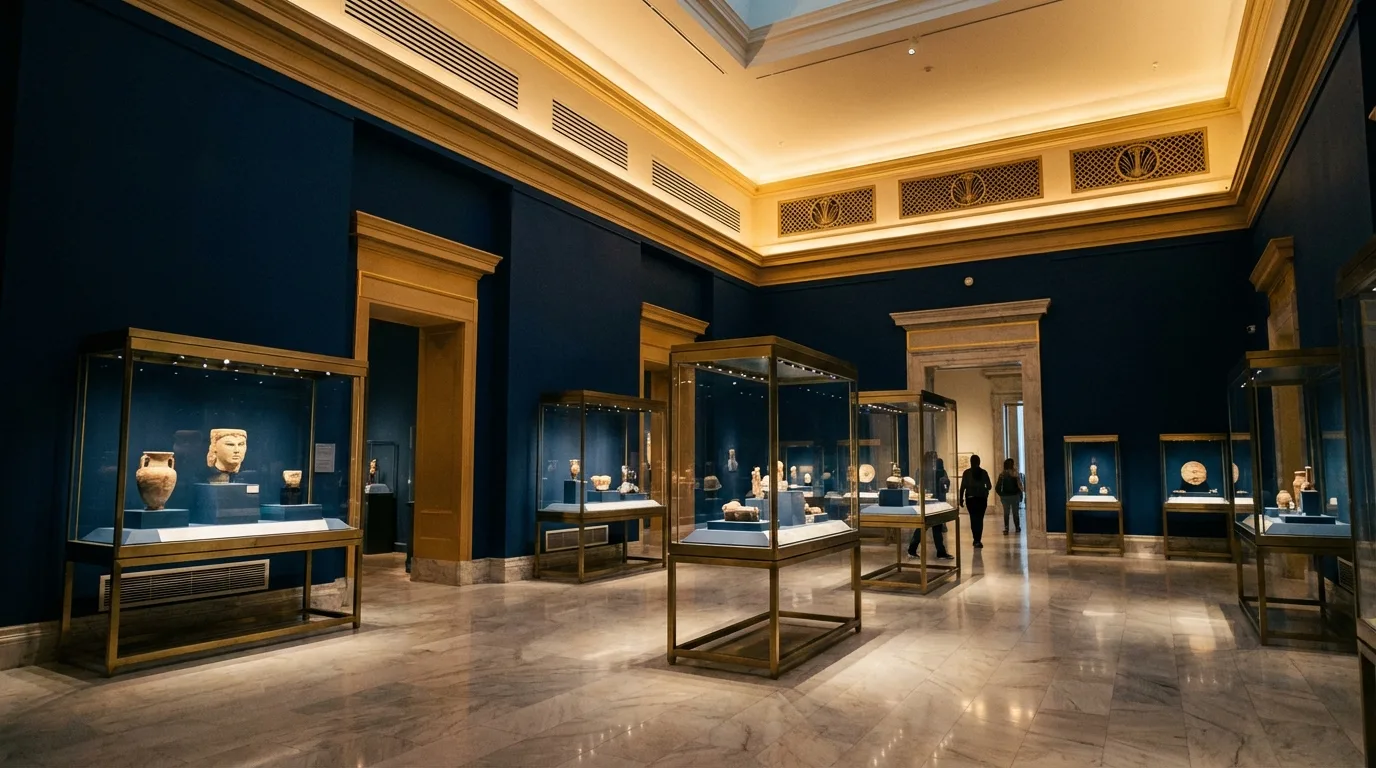
HVAC design for museums and archives represents the highest technical threshold among all special public venues. Here, the HVAC system serves not "people" but "objects" — potentially millennia-old artifacts, precious paintings and calligraphy, photographic negatives, or historical archives. Even minor fluctuations in temperature and humidity can cause irreversible damage, so environmental control precision requirements far exceed those of conventional building HVAC.
Temperature and Humidity Standards for Artifact Preservation
According to the ASHRAE Handbook — HVAC Applications, Chapter 24 (Museums, Galleries, Archives, and Libraries)[1], museum environmental control is classified into five grades: AA, A, B, C, and D. Grade AA requires temperature fluctuations not exceeding ±0.5°C and relative humidity fluctuations not exceeding ±3% RH, with no seasonal drift permitted, applicable to the most precious national treasure exhibition halls. General permanent exhibition halls typically target Grade A, allowing short-term temperature fluctuation of ±1°C, short-term humidity fluctuation of ±5% RH, seasonal temperature drift of 5°C, and seasonal humidity drift of 10% RH.
For typical settings in Taiwan museums, exhibition hall temperatures are usually set at 22°C ±1°C (winter) to 24°C ±1°C (summer), with relative humidity at 55% ±5% RH. However, different materials have different environmental preferences — paper documents and paintings prefer lower humidity (45% to 55% RH), wood and lacquerware require stable moderate humidity (50% to 60% RH), and metal artifacts need low-humidity environments (40% to 45% RH) to prevent oxidative corrosion. This means large museums often need to divide different environmental control zones based on exhibit types, with each zone independently regulated.
Precision HVAC System Design Essentials
To achieve museum-grade environmental control precision, the HVAC system design requires special attention to the following aspects:
- Chilled Water Temperature Control Precision: The stability of chilled water supply temperature directly affects supply air temperature fluctuations. Variable-frequency chillers paired with precision temperature control valves (control accuracy ±0.3°C) are recommended, with chilled water supply temperature stability of at least ±0.5°C
- Reheat and Humidification/Dehumidification Mechanisms: Precision environmental control requires simultaneous cooling, reheating, humidification, and dehumidification capabilities. During winter or low-load conditions, humidity is controlled through cooling coil dehumidification and reheat coil temperature recovery; during high-load conditions, cooling coils handle both sensible and latent heat simultaneously. Humidifier selection should avoid generating particulate contamination — electrode-type or infrared steam humidifiers are most suitable
- Air Filtration System: Museum air filtration requires not only dust removal (recommended pre-filter G4 plus intermediate F7 or higher) but also activated carbon or chemical filters to remove SO2, NO2, O3, and other acidic gases harmful to artifacts[1]
- Air Velocity and Uniformity: Air velocity within exhibition halls should not exceed 0.15 m/s to avoid physical disturbance to suspended paintings or lightweight exhibits. Supply air outlets should feature low-velocity, large-area diffusion design and avoid direct airflow onto exhibit surfaces
Special Considerations for Archives
Archives have environmental control requirements similar to museums but with distinct characteristics. Optimal preservation conditions for paper archives are 16°C to 20°C temperature and 30% to 40% RH relative humidity[6], well below the human comfort range. This means archive storage rooms are typically unoccupied environments, and HVAC system design can disregard human comfort entirely, optimizing solely for document preservation. Photographic negatives and magnetic tape archives require even more stringent conditions — low temperatures (10°C to 15°C) and lower humidity (25% to 35% RH). Additionally, archive fire suppression systems (typically inert gas systems) must be coordinated with HVAC design to ensure that when fire suppression activates, the HVAC system immediately closes fire dampers and stops airflow to maintain effective inert gas concentrations.
Need environmental control system planning for special public venues? Contact our engineering team for a professional design solution tailored to your venue's characteristics.
4. Healthcare Facility Public Areas: Infection Control and Ventilation Standards
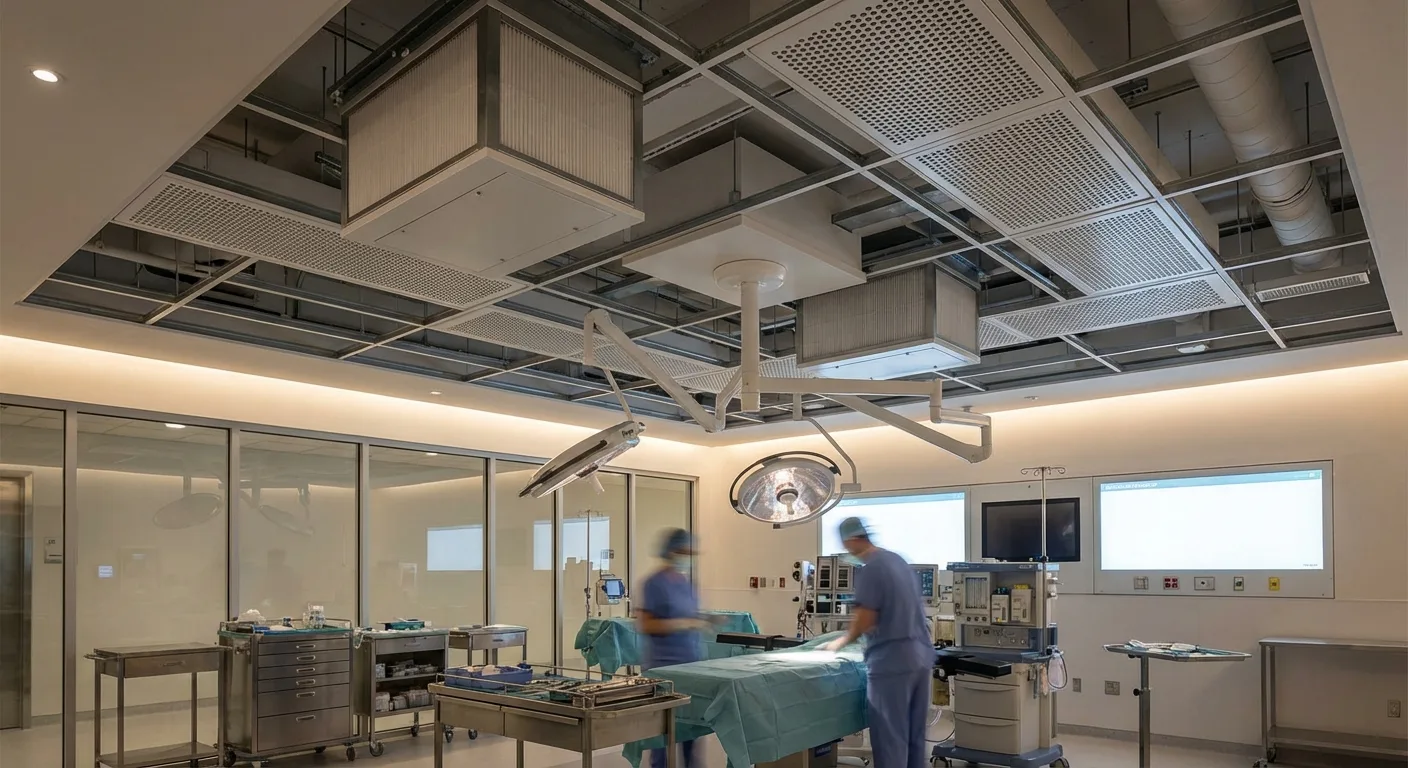
HVAC design for healthcare facilities is a highly regulated domain. Unlike the venues discussed earlier where "comfort" or "artifact preservation" are primary objectives, the foremost mission of healthcare HVAC is "infection control" — preventing the spread of pathogenic microorganisms within the facility through precise airflow direction control, adequate air change rates, and appropriate pressure differential management. While operating rooms, negative-pressure isolation rooms, and other specialized medical spaces have extensive HVAC literature, public areas of healthcare facilities — outpatient lobbies, waiting areas, corridors, and elevator lobbies — also present unique environmental control challenges.
Ventilation and Pressure Differential Standards for Public Areas
According to ASHRAE Standard 170 (Ventilation of Health Care Facilities)[3], each type of space in healthcare facilities has defined minimum air change rates and pressure relationship requirements. Outpatient waiting areas require a minimum total air change rate of 6 per hour (6 ACH), with outdoor air changes of at least 2 ACH. Corridors require a minimum total air change rate of 2 ACH. Public restrooms must maintain exhaust rates above 10 air changes per hour with negative pressure to prevent odor and pathogen spread into corridors.
Pressure differential management is a key concept in healthcare HVAC design. The pressure design principle for public areas is: clean zones maintain positive pressure, contaminated zones maintain negative pressure, with airflow moving from clean to contaminated areas. Outpatient lobbies and waiting areas typically maintain slight positive pressure (+2.5 Pa to +5 Pa) to prevent untreated outdoor air infiltration. Emergency department waiting areas, due to potential exposure to infectious patients, require special attention to enhanced ventilation rates and airflow direction control.
Air Filtration and Disinfection Technologies
Air treatment in healthcare facility public areas should include effective microbial control measures:
- High-Efficiency Filtration: AHUs serving outpatient and waiting areas should be equipped with at least MERV-14 grade high-efficiency filters, capable of capturing over 90% of particles 0.3 micrometers and larger, effectively reducing airborne microbial concentrations
- Ultraviolet Germicidal Irradiation (UVGI): UVC ultraviolet lamps (254 nm wavelength) installed inside AHUs irradiate air passing over coil surfaces and filters. Per CDC guidelines, UVC irradiation dosage should achieve effective inactivation levels for Mycobacterium tuberculosis
- Return Air Management: HVAC systems for healthcare facility public areas should carefully evaluate the use of return air. In areas with higher infection risk (such as emergency department waiting areas), full outdoor air systems or at least 50% outdoor air ratios are recommended to dilute indoor air contaminant concentrations
Taiwan Healthcare Facility Regulatory Framework
In Taiwan, healthcare facility HVAC design must comply with ventilation requirements in building technical regulations[4], as well as environmental condition specifications in the Ministry of Health and Welfare's healthcare facility establishment standards. Additionally, CNS 12575 (Indoor Air Quality Standard)[7] sets regulatory limits for CO2 concentration, formaldehyde concentration, and PM2.5 concentration in healthcare facilities, and HVAC system design must ensure compliance with these standards even at maximum occupant density. The COVID-19 pandemic experience further highlighted the importance of ventilation system design in healthcare facility public areas, with many facilities undertaking post-pandemic ventilation system upgrades including enhanced outdoor air processing capacity, strengthened air filtration grades, and implementation of real-time air quality monitoring systems.
5. Heritage and Historic Buildings: HVAC Retrofit Constraints and Solutions
HVAC engineering for heritage and historic buildings is the most challenging type among all special venues. In these buildings, "preservation" always takes priority over "comfort" — any HVAC equipment installation must not compromise the building's historic value, structural integrity, or aesthetic character. Under Taiwan's Cultural Heritage Preservation Act[6], heritage building restoration and adaptive reuse must be reviewed and approved by the competent authority, with HVAC engineering design proposals also subject to review.
Fundamental Principles for Heritage Building HVAC Design
The international cultural heritage preservation community has established the following fundamental principles for equipment improvements in heritage buildings:
- Reversibility Principle: All newly added equipment and piping must be installed without damaging original building structures, and must be completely removable in the future without leaving permanent traces
- Minimum Intervention Principle: HVAC system design should achieve environmental control objectives with the fewest building modifications. In selecting piping routes, priority should be given to utilizing existing shafts, ceiling spaces, or underfloor spaces, avoiding new penetrations in historic walls
- Compatibility Principle: The materials and appearance of new equipment should not create jarring conflicts with the building's historic style. Terminal elements such as diffusers and return air grilles should feature customized designs harmonious with the architectural style
- Gradualism Principle: Avoid drastically altering the environmental conditions of heritage buildings all at once, to prevent damage such as wood member cracking, plaster peeling, or paint fading caused by rapid temperature and humidity changes
Common Technical Solutions
For HVAC improvements in heritage buildings, the following technical approaches are commonly employed in practice:
- Split or VRF Systems: Compared to central HVAC systems requiring extensive ductwork space, split or VRF (Variable Refrigerant Flow) systems have compact indoor units and thin refrigerant piping (6 to 16 mm), making concealed installation easier in the limited spaces of heritage buildings[8]
- Localized Environmental Control Strategy: Rather than attempting full building HVAC coverage, only important exhibition spaces or artifact storage areas receive localized precision environmental control. This approach significantly reduces piping and equipment quantities, minimizing intervention in the building
- Passive Environmental Control Augmentation: Fully leveraging the passive environmental control features inherent to heritage buildings — thick walls, deep windows, natural ventilation design — supplemented by minimized active HVAC equipment. For example, smart window control systems can open ventilation windows at appropriate times, reducing mechanical ventilation usage
- Outdoor Unit Concealment: Air conditioning outdoor units should be placed in locations that do not affect the visual appearance of the building's primary facades, with screening by architectural-style-consistent grilles or landscaping as needed. Equipment noise and vibration must also be strictly controlled to avoid long-term impacts on building structures
Practical Challenges for Heritage Buildings in Taiwan
Taiwan possesses numerous Japanese colonial-era and Qing dynasty historic buildings that universally face HVAC improvement needs during adaptive reuse. However, these buildings often have insufficient structural load-bearing capacity (unable to support heavy HVAC equipment), extremely limited piping space (lacking modern building service shafts), and strict facade regulations (prohibiting equipment installation on exterior walls). In the Kaohsiung region, the hot and humid subtropical climate further intensifies heritage building environmental control challenges — without air conditioning, indoor temperatures in heritage buildings can exceed 35°C in summer with relative humidity above 80%, unsuitable for both human occupancy and preservation of interior artifacts or building components[9]. Consequently, heritage building HVAC design must seek optimal compromise solutions through creative engineering approaches within strict constraints.
6. Integrated BMS Monitoring and Energy Management
Whether for courthouses, legislatures, museums, or healthcare facilities, HVAC systems in special public venues share the common characteristics of "high monitoring requirements and minimal tolerance for error." A comprehensive Building Management System (BMS) is not merely a tool for improving operational efficiency but an essential infrastructure for ensuring environmental control quality and real-time response to abnormal conditions.
BMS Architecture and Monitoring Point Planning
The BMS system architecture for special public venues should encompass complete planning from the field sensing layer, control layer, to management layer:
- Field Sensing Layer: Configure appropriate sensors based on venue characteristics — museum exhibition halls should have one set of temperature and humidity sensors per 50 to 100 square meters (precision requirements: temperature ±0.3°C, humidity ±2% RH); courthouse courtrooms need noise meters and CO2 sensors; healthcare facility public areas need differential pressure gauges to monitor pressure relationships[10]
- Control Layer: DDC (Direct Digital Controllers) execute PID loop control for each zone, achieving closed-loop automatic regulation of temperature, humidity, pressure differential, and CO2 concentration. Controllers communicate via BACnet or Modbus protocols, ensuring system openness and interoperability
- Management Layer: Central monitoring workstations provide facility-wide real-time environmental status display, historical trend recording, abnormal alarm notification, and energy consumption statistics. For museum-grade applications, the management layer should also feature environmental risk early warning functionality — automatically sending alerts to management personnel when temperature and humidity continuously deviate from setpoints beyond preset durations
Energy Management and Efficiency Optimization
HVAC systems in special public venues often have higher energy intensity due to high environmental control precision requirements (requiring simultaneous cooling and reheating), long operating hours (24-hour operation for museums and archives), or high ventilation rates (outdoor air requirements for healthcare facilities). Therefore, energy management strategy design is critical:
- Heat Recovery Systems: In venues requiring simultaneous cooling and reheating (such as museums), condenser-side waste heat can serve as the reheat heat source, avoiding additional electric heating energy consumption. Energy Recovery Ventilators (ERVs) can recover sensible and latent heat from exhaust air, reducing outdoor air processing energy consumption[11]
- Demand-Driven Control: Dynamically adjust HVAC operation based on actual usage conditions. Courthouses can link to court session scheduling systems to automatically switch unscheduled courtrooms to standby mode; museums can adjust exhibition hall environmental control stringency based on opening and closing hours (allowing wider temperature and humidity fluctuation ranges during closed hours)
- Energy Performance Indicator (KPI) Tracking: Establish Energy Use Intensity (EUI) baselines for each venue type, tracking HVAC system energy performance in kWh/m²/year. ASHRAE literature provides EUI reference values for museums, healthcare facilities, and other venue types, serving as benchmarks for performance evaluation
Preventive Maintenance and Data-Driven Decision Making
Long-term operational data accumulated by BMS, in addition to real-time monitoring, can support the implementation of preventive maintenance strategies. By analyzing long-term trends in equipment operating parameters — such as monthly COP variations of chillers, progressive pressure differential curves of AHU filters, and seasonal efficiency degradation of coils — maintenance needs can be predicted before equipment failure, scheduling optimal maintenance timing[12]. For museums and similar venues highly sensitive to environmental control interruptions, preventive maintenance not only reduces repair costs but more importantly avoids the risk of environmental condition loss-of-control damage to artifacts caused by sudden equipment failures.
Conclusion
HVAC design for special public venues is the professional domain within refrigeration and air conditioning engineering that most requires cross-disciplinary integration capability. Large-space airflow distribution and acoustic control for courthouses and legislatures, precision constant temperature and humidity regulation for museums and archives, infection prevention ventilation strategies for healthcare facility public areas, environmental control solutions for heritage buildings under strict preservation constraints, and the BMS integrated monitoring that connects all venues — each requires deep engineering expertise, profound understanding of venue missions, and precise command of regulatory standards.
Under the subtropical climate conditions of Kaohsiung and southern Taiwan, the HVAC challenges for these special venues are even more severe: the hot and humid environment doubles museum dehumidification loads, accelerates material deterioration in heritage buildings, and increases infection risks in healthcare facilities. Only by using international standards as design references, local experience as practical foundations, and BMS data as the driving force for continuous improvement can the most appropriate environmental control solutions be custom-tailored for each special public venue, simultaneously achieving the multiple objectives of functional mission fulfillment, occupant health, cultural preservation, and energy sustainability.