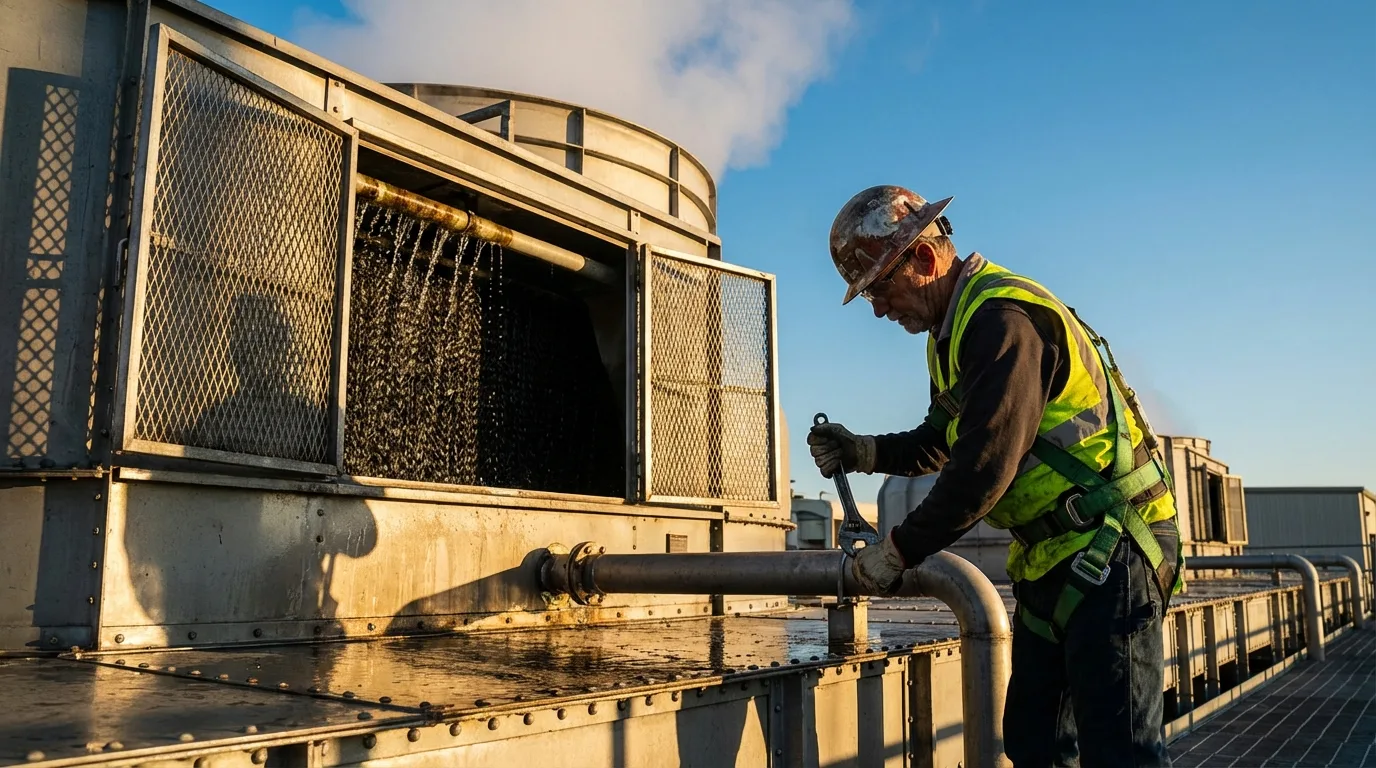
The Cooling Tower is a critical piece of equipment in water-cooled central air conditioning systems responsible for rejecting condensing waste heat to the atmosphere, functioning as the system's "lifeline." A well-maintained cooling tower enables the chiller to operate at optimal condensing temperatures, saving significant compressor power. Conversely, if water quality management fails, fill media becomes clogged, or biofilm proliferates, not only does system energy efficiency decline sharply, but the tower can also become a breeding ground for Legionella pneumophila, posing serious health threats to surrounding populations[1]. According to the U.S. Centers for Disease Control and Prevention (CDC), cooling towers are among the most common environmental infection sources for community-acquired Legionnaires' disease outbreaks[2]. In Taiwan's high-temperature, high-humidity climate, cooling tower maintenance must be planned and executed with systematic management thinking. This article proceeds from cooling tower operating principles through water quality management indicators, chemical water treatment programs, Legionella prevention measures, scheduled maintenance routines, and performance optimization strategies, providing a comprehensive reference guide directly applicable to engineering practice.
1. Cooling Tower Operating Principles Review
The Basic Mechanism of Evaporative Cooling
The cooling tower's heat rejection principle is evaporative cooling. When cooling water comes into direct contact with flowing air inside the tower, a small portion of water molecules at the surface gain sufficient kinetic energy to evaporate into water vapor, and the evaporation process absorbs a large amount of latent heat of vaporization (approximately 2,257 kJ/kg), causing the temperature of the remaining circulating cooling water to decrease[3]. In practice, approximately 80% of cooling tower heat rejection comes from evaporative latent heat transfer, with only about 20% from sensible heat exchange between water and air. This means cooling tower heat rejection performance is highly dependent on the moisture-carrying capacity of the incoming air -- that is, the wet-bulb temperature of the incoming air.
Wet-Bulb Temperature and Cooling Limits
The wet-bulb temperature is the theoretical limit for cooling tower heat rejection. Under ideal conditions, cooling water can be cooled to the incoming air wet-bulb temperature, but this limit cannot be achieved in actual engineering. The difference between the cooling water leaving temperature and the incoming air wet-bulb temperature is called the approach temperature, which is the core indicator for measuring cooling tower performance[4]. Typical commercial HVAC systems have a design approach temperature of 3-5°C. Taking southern Taiwan as an example, the summer design wet-bulb temperature is approximately 28°C, with a design approach of 4°C, yielding a design cooling water leaving temperature of 32°C.
Approach Temperature and Cooling Capacity
A smaller approach temperature indicates higher cooling tower performance, but achieving a smaller approach requires exponentially greater tower area and airflow, with rapidly diminishing economic returns. In the context of maintenance management, approach temperature is an important diagnostic indicator for cooling tower health -- when a cooling tower's approach temperature deteriorates from the design value of 4°C to 7-8°C, it typically indicates that fill media clogging, uneven water distribution, or insufficient airflow has already occurred, requiring immediate maintenance intervention[5].
Fill Media Efficiency and Water-Air Contact Area
The function of cooling tower fill media is to spread cooling water into thin films or small droplets, increasing the contact area and contact time between water and air, thereby enhancing heat and mass transfer efficiency. Common film fill can provide over 200 square meters of specific surface area per cubic meter, greatly enhancing evaporative cooling effectiveness. However, the high specific surface area of fill media also means its channels are extremely narrow (typically 12-19 mm), and once suspended solids, algae, or biofilm accumulate on fill surfaces, channels gradually clog, reducing heat transfer area, increasing airflow resistance, and rapidly degrading cooling performance[4]. This is precisely why water quality management occupies a central role in cooling tower maintenance.
2. Four Key Water Quality Indicators
The cooling water system is an open circulation system where water comes into direct contact with large volumes of air inside the tower, continuously absorbing dust, microbial spores, and gases, combined with evaporative concentration effects, making water quality management the most technically demanding aspect of cooling tower maintenance[6]. The following four indicators form the foundational monitoring framework for water quality management.
Indicator 1: pH Value
pH value measures water's acidity or alkalinity and directly affects the scaling tendency and corrosion rate of the cooling water system. Cooling water pH should generally be maintained in the mildly alkaline range of 7.0-8.5. pH too low (<7.0) accelerates acidic corrosion of metal pipe walls, particularly copper tube condensers and carbon steel piping; pH too high (>9.0) promotes precipitation of calcium carbonate and other scale deposits on high-temperature surfaces. The Langelier Saturation Index (LSI) is a commonly used indicator for comprehensively assessing water's scaling or corrosion tendency -- a positive LSI indicates scaling tendency, negative indicates corrosion tendency, with the ideal control target maintaining LSI between +0.5 and -0.5[6]. In practice, pH should be measured daily and regulated in real time with automated chemical dosing systems.
Indicator 2: Conductivity
Conductivity reflects the total concentration of dissolved ions in water, measured in μS/cm (microsiemens per centimeter). Since evaporation only removes pure water, dissolved solids continuously concentrate in the circulating water, causing conductivity to rise steadily during operation. Cooling water conductivity is generally controlled below 1,500 μS/cm; excessively high conductivity indicates that calcium, magnesium, chloride, and other ions have become highly concentrated, with simultaneously elevated scaling and corrosion risks. Conductivity is the most commonly used trigger parameter for automatic blowdown control -- when conductivity exceeds the set upper limit, the automatic blowdown valve opens to discharge high-concentration water and replenish with fresh make-up water, thereby maintaining target cycles of concentration[7].
Indicator 3: Cycles of Concentration (CoC)
Cycles of Concentration (CoC) is defined as the ratio of a dissolved indicator (typically conductivity or chloride concentration) in the cooling water to the same indicator in the make-up water. For example, if make-up water conductivity is 300 μS/cm and cooling water conductivity is 1,200 μS/cm, the cycles of concentration is 4. The CoC setting represents a balance between water conservation and water quality risk[6]. Increasing CoC from 2 to 4 can reduce blowdown volume by approximately 50%, with corresponding make-up water reduction; however, calcium and magnesium ion concentrations increase twofold, significantly elevating scaling risk. General HVAC cooling water system CoC is controlled at 3-5, with specific values depending on make-up water quality (particularly hardness and alkalinity) and chemical water treatment program capability. Under Taiwan's generally low tap water hardness (50-150 mg/L as CaCO₃), most systems can operate stably at 4-5 CoC.
Indicator 4: Bacterial Count and Legionella Testing
Microbial control is the water quality management aspect most directly related to public health safety. The warm (25-45°C), nutrient-rich, and continuously aerated environment of cooling water systems is an ideal culture medium for bacteria, algae, and fungi. Heterotrophic Plate Count (HPC) is the baseline indicator for assessing overall microbial activity and should be controlled below 10,000 CFU/mL[1]. More importantly, specific testing for Legionella pneumophila is essential. ASHRAE Guideline 12 recommends an action threshold of 1,000 CFU/L for Legionella in cooling water -- exceeding this value should trigger enhanced disinfection procedures; if exceeding 10,000 CFU/L, the system should be immediately shut down for disinfection and comprehensive cleaning[8]. Legionella testing should be performed at least quarterly, with monthly testing recommended for high-risk locations (such as cooling towers near hospitals or nursing homes).
3. Chemical Water Treatment Programs
Chemical water treatment is the technical core of cooling water system maintenance, aimed at simultaneously controlling scaling, corrosion, and microbial growth. A complete chemical water treatment program includes scale inhibitor, biocide, and corrosion inhibitor formulation design, as well as automated dosing system and blowdown water control integration[6].
Scale Inhibitors
Scale inhibitors interfere with the formation and growth of scale crystal nuclei, allowing dissolved calcium and magnesium ions to remain stable in solution under supersaturated conditions without precipitating. Common scale inhibitor types include: organophosphonate-based compounds (such as HEDP, ATMP), which inhibit calcium carbonate crystallization through chelation and crystal lattice distortion mechanisms; polymer dispersants (such as polyacrylic acid, maleic acid copolymers), which disperse already-formed micro-scale particles in water to prevent aggregation. Scale inhibitor dosing concentrations must be calculated based on make-up water quality, cycles of concentration, and system temperature, generally in the 10-50 ppm range[7]. Excessive dosing not only wastes chemical costs but can actually promote calcium phosphate scale formation at high phosphonate concentrations.
Biocides: Chlorine-Based and Non-Chlorine
Biocides control microbial populations in cooling water, including planktonic bacteria, sessile bacteria (biofilm), and algae. Biocides can be divided into oxidizing and non-oxidizing categories[9]:
- Oxidizing Biocides (Chlorine-Based): Including sodium hypochlorite (bleach), chlorine dioxide, and bromine-based oxidizers. Chlorine-based biocides offer low cost and broad-spectrum effectiveness, making them the most widely used cooling water biocide solution. Maintaining free residual chlorine at 0.5-1.0 ppm effectively suppresses most microorganisms. However, chlorine's biocidal efficacy significantly decreases at high pH (>8.0), and it can accelerate corrosion of certain metals. Bromine-based oxidizers maintain superior biocidal efficacy in high pH environments compared to chlorine, making them suitable for alkaline water systems
- Non-Oxidizing Biocides: Including isothiazolinone, DBNPA (dibromonitrilopropionamide), glutaraldehyde, and others. Non-oxidizing biocides are typically applied through periodic slug dosing, offering superior penetration and removal effectiveness against biofilm. Weekly or bi-weekly slug dosing is recommended, alternating with daily oxidizing biocide treatment to prevent microbial resistance development
Corrosion Inhibitors
Corrosion inhibitors form a protective film on metal pipe wall surfaces, blocking dissolved oxygen and corrosive ions from attacking the base metal. Commonly used corrosion inhibitors include[6]:
- Molybdate-Based: Environmentally friendly with good corrosion inhibition for both carbon steel and copper alloys, but higher unit cost
- Zinc-Based: Excellent corrosion inhibition for carbon steel when blended with phosphate or phosphonate, but zinc ion content in discharge water is subject to environmental regulations
- Organophosphonate-Based: Offers dual scale inhibition and corrosion inhibition functions, forming the most commonly used composite water treatment chemical base
- Polymer-Type Corrosion Inhibitors: New-generation environmentally friendly formulations free of heavy metals and phosphorus, suitable for locations with strict discharge water regulations
Automated Dosing Systems
Modern cooling water treatment is highly automated. Core components of automated dosing systems include: conductivity controllers (triggering blowdown valves to control cycles of concentration), pH controllers (regulating acid/alkali chemical dosing), ORP controllers (monitoring effective concentration of oxidizing biocides), and timers (controlling non-oxidizing biocide slug dosing cycles). Advanced systems further integrate remote monitoring platforms, enabling water treatment service providers to track real-time trends in water quality parameters via cloud platforms and remotely adjust dosing logic[7]. Automated dosing system sensors (conductivity probes, pH probes, ORP probes) require regular calibration (monthly recommended), as sensor measurement deviation directly leads to dosing control inaccuracy.
Blowdown Control
Blowdown control is the most direct means of maintaining cooling water cycles of concentration. The relationship between blowdown volume, evaporation loss, and target cycles of concentration is: Blowdown = Evaporation Loss / (CoC - 1). For a 500-ton cooling water system, the evaporation loss rate is approximately 1% of the circulation flow (about 6.5 L/min); with a target CoC of 4, the blowdown rate is approximately 6.5 / (4-1) = 2.2 L/min. Blowdown methods are divided into continuous and intermittent: continuous blowdown maintains more stable water quality but requires precise flow control; intermittent blowdown uses conductivity as the trigger signal, offering simpler operation but greater water quality fluctuation[6]. From a water conservation perspective, increasing CoC significantly reduces blowdown and make-up water volumes, but must be accompanied by sufficient chemical water treatment capability to control scaling risk.
4. Legionella Prevention Measures
Legionnaires' Disease is a severe atypical pneumonia caused by Legionella pneumophila, with a fatality rate of 10-25%. Cooling towers are recognized as one of the primary environmental transmission sources due to their temperature range, nutrient content, and aerosol generation mechanism[2]. This section establishes a systematic prevention framework from three perspectives: pathogen characteristics, international standards, and disinfection protocols.
Growth Conditions of Legionella pneumophila
Legionella pneumophila is a gram-negative bacillus widely present in natural water bodies. Conditions for its proliferation in engineered water systems include[1]:
- Temperature 20-45°C: Legionella rapidly proliferates in the 25-42°C range, with optimal growth at 35-40°C. Cooling water system operating temperature ranges (typically 30-37°C) fall precisely within this interval. Below 20°C, the organism enters dormancy but does not die; effective killing requires temperatures above 55°C
- Stagnant Water Zones: Areas with slow or still water flow (such as dead-leg pipe sections, unused branch lines, sediment beneath basin corners) readily form Legionella habitats
- Biofilm Protection: In natural environments, Legionella primarily parasitizes protozoa (such as amoeba). Biofilm on cooling water system pipe walls and fill media surfaces serves as a sanctuary for protozoa and Legionella, enabling them to resist biocide action
- Nutrients: Organic carbon sources, rust, zinc ions, and other substances in water promote Legionella growth
Drift aerosol droplets produced by cooling towers are predominantly in the 1-5 μm particle size range, which can be inhaled and reach deep into the lung alveoli -- this is the key mechanism by which cooling towers become Legionnaires' disease transmission risk sources[8].
ASHRAE 188 Water Management Plan
ASHRAE Standard 188-2018 "Legionellosis: Risk Management for Building Water Systems" is currently the most authoritative standard for Legionella risk management in building water systems[1]. The standard requires building owners and managers to establish a written Water Management Program (WMP), with a core framework including:
- Establish a Water Management Team: Composed of cross-disciplinary members including facility managers, water treatment service providers, and infection control practitioners (healthcare facilities)
- Create Water System Flow Diagrams: Identifying all cooling towers, hot water systems, decorative water features, and other water system equipment with Legionella risk
- Identify Risk Control Points: Identifying control points where water temperature falls in the 20-45°C range, stagnant water zones exist, or aerosol generation potential is present
- Establish Control Measures and Monitoring Procedures: Setting control parameters such as temperature and biocide concentration and monitoring frequency for each control point
- Define Corrective Actions: Standard response procedures when monitoring results fall outside control ranges
- Documentation and Periodic Review: All monitoring records, corrective actions, and annual plan reviews
WHO Guidelines and International Regulatory Trends
The World Health Organization (WHO) provides a global guidance framework for cooling tower Legionella management in its technical report "Legionella and the Prevention of Legionellosis"[10]. WHO recommends that all open cooling towers should be included in Legionella risk management, emphasizing the following key principles: maintaining effective biocide residual concentrations, regularly cleaning cooling towers to remove biofilm and sediment, and avoiding restarting cooling water systems after extended shutdown periods without prior disinfection. The EU, Singapore, Australia, and other regions have incorporated cooling tower Legionella management into regulatory requirements with mandatory registration and periodic testing. While Taiwan does not yet have specific mandatory regulations for cooling tower Legionella, the implementation of the Indoor Air Quality Management Act and the progressive strengthening of related environmental regulations indicate that management intensity on this issue is accelerating[11].
Disinfection Protocols: Thermal and Chemical
When Legionella test results for the cooling water system exceed the action threshold (1,000 CFU/L), or before restarting after extended shutdown, enhanced disinfection procedures should be implemented. Major disinfection protocols include[8]:
- Chemical Disinfection (High-Concentration Chlorination): Elevating free residual chlorine in the cooling water system to 5-10 ppm and maintaining circulation for 4-6 hours before discharge. This method is straightforward to implement, but high chlorine concentrations are corrosive to system metals and should not be maintained for extended periods. After disinfection, the system must be flushed to normal residual chlorine range before resuming operation
- Chemical Disinfection (Chlorine Dioxide): Chlorine dioxide has superior biofilm penetration compared to hypochlorous acid and maintains good biocidal efficacy across a broad pH range (6-10). Disinfection concentration is 0.5-1.0 ppm, maintained for 6 hours or more
- Thermal Disinfection: Raising cooling water system temperature above 60°C and maintaining for at least 2 hours. Thermal disinfection is the most definitive method for Legionella elimination, but for cooling water tower systems, the practical feasibility is limited due to the need for external heat sources to heat large water volumes, and it is primarily used for hot water system disinfection
- UV Disinfection: Installing UV disinfection units in the cooling water circuit can serve as a supplementary daily biocidal measure. UV dosage must reach 40 mJ/cm² or above to effectively kill Legionella[2]
Regardless of the disinfection protocol used, physical cleaning should be performed before disinfection (scrubbing the basin, flushing fill media, removing sediment), removing the biofilm's protective barrier to allow disinfectant direct contact with bacterial cells. After disinfection, Legionella sampling and testing should be repeated to confirm bacterial counts have been reduced to safe levels.
5. Scheduled Preventive Maintenance
Systematic preventive maintenance scheduling is key to ensuring long-term stable cooling tower operation. The following lists practical maintenance items organized by daily, weekly, monthly, quarterly, and annual frequency[5].
Daily Maintenance Items
- Visual inspection of cooling tower operating status: verify fan rotation direction is correct, check for abnormal vibration or noise
- Record cooling water entering and leaving tower temperatures, cooling range, and approach temperature
- Confirm basin water level is normal and make-up water float valve operates correctly
- Check automated dosing system chemical inventory and pump operation indicators
- Visual confirmation of cooling water appearance (color, clarity, presence of foam or odor)
Weekly Maintenance Items
- Measure cooling water pH, conductivity, and residual biocide concentration (free chlorine or ORP)
- Calculate and record weekly cycles of concentration (comparing cooling water and make-up water conductivity)
- Check basin interior for abnormal sediment, algae growth, or insects
- Remove leaves, lint, and other debris from tower air intake screens
- Confirm blowdown control valve operates normally
Monthly Maintenance Items
- Calibrate automated dosing system sensors (conductivity meter, pH meter, ORP meter) using standard solutions
- Check distribution nozzle water flow pattern for uniformity, clear clogged nozzles
- Inspect and clean side-stream filter or sand filter media
- Fan gearbox oil level check (gear-driven type) or belt tension and wear inspection (belt-driven type)
- Inspect tower structural components for loosening, corrosion, or damage
- Perform Legionella rapid testing (monthly recommended for high-risk locations, quarterly for general locations)
Quarterly Maintenance Items
- Cooling tower performance testing: measure approach temperature and compare with design value and historical records
- Legionella culture testing (standard culture method, results require approximately 10-14 days)
- Cooling water system corrosion coupon retrieval and analysis -- evaluate whether corrosion rate is within control range (carbon steel <3 mpy, copper alloy <0.5 mpy)
- Visual inspection of fill media surfaces -- observe for biofilm coverage, sediment accumulation, or structural deformation
- Non-oxidizing biocide slug dosing (enhanced biocidal treatment coinciding with seasonal transitions)
- Water treatment service report review and quarterly water management plan assessment[1]
Annual Maintenance Items (Annual Overhaul)
- Thorough fill media cleaning: high-pressure water jet flushing or chemical soak cleaning to remove accumulated biofilm, algae, and mineral deposits
- Inspect drift eliminator integrity, replace deformed or damaged eliminator segments, ensuring drift rate remains at or below design value (<0.005%)
- Comprehensive fan assembly maintenance: blade balance correction, gearbox lubricant replacement, bearing lubrication and clearance inspection, motor insulation resistance measurement (>5 MΩ)
- Comprehensive structural inspection: FRP shell crack and UV degradation assessment, galvanized steel frame corrosion measurement, bolt torque re-tightening
- Basin anti-corrosion coating inspection and localized repair
- Drain valve, overflow pipe, make-up water piping, and float valve inspection and replacement
- Motor current and vibration baseline measurements for predictive maintenance comparison[5]
Fill Media Replacement Timing
Cooling tower fill media service life is typically 8-15 years, depending on water quality management quality, UV exposure, and fill material. The following indicators suggest fill media needs replacement[4]:
- Approach temperature has persistently deteriorated more than 3°C above design value and cannot be restored after cleaning
- Fill media surfaces show obvious structural deformation (collapse, bending, channel closure)
- PVC fill media shows embrittlement, crumbling upon contact (a typical sign of UV degradation)
- Large-area mineral deposits exist inside fill media that cannot be removed by flushing or chemical cleaning
Fan Motor Maintenance
Cooling tower fan motors operate long-term in high-temperature, high-humidity environments and have relatively high failure rates. Key fan motor maintenance items include: regular measurement of motor insulation resistance to detect winding moisture or deterioration, bearing vibration monitoring and lubrication management, current value trend tracking to detect mechanical load abnormalities, and periodic gearbox gear oil replacement and oil quality analysis. For fan motors equipped with Variable Frequency Drives (VFDs), VFD cooling fan, capacitor condition, and output waveform quality should also be inspected[3].
Structural Inspection Key Points
Cooling tower structural components are long-term exposed to high-temperature, high-humidity, chemically-treated corrosive environments. Galvanized steel components may exhaust their zinc coating within 10-15 years, entering an accelerated corrosion phase; FRP components gradually deteriorate and embrittle under prolonged UV exposure. Annual structural inspections should include: zinc coating thickness measurement (using magnetic thickness gauges), weld joint and bolt connection integrity verification, basin bottom corrosion pit depth measurement, and support structure deflection and stability assessment.
Need to develop a professional cooling tower maintenance plan or Legionella risk assessment? Contact our engineering team for customized water management solutions.
6. Performance Optimization and Energy Savings
Cooling tower performance optimization not only reduces its own energy consumption but more importantly improves overall HVAC system performance by lowering condensing temperatures. The following are several key performance optimization strategies[3].
Variable Frequency Drive (VFD) Fan Control Strategies
Cooling tower fan energy consumption accounts for approximately 5-8% of central HVAC system total energy consumption. Traditional constant-speed fans can only operate at full speed or off, causing large cooling water temperature fluctuations and energy waste at partial loads. With Variable Frequency Drive (VFD) implementation, fan speed can be continuously adjusted based on actual heat rejection needs. According to Fan Affinity Laws, fan power is proportional to the cube of speed[12]:
- Speed reduced to 80%: Power = 0.8³ = 0.512, only 51% of rated power
- Speed reduced to 60%: Power = 0.6³ = 0.216, only 22% of rated power
- Speed reduced to 50%: Power = 0.5³ = 0.125, only 13% of rated power
VFD control strategies typically target tracking a cooling water leaving temperature setpoint. The controller adjusts fan speed through a PID control loop based on the deviation between measured leaving water temperature and setpoint. In systems with multiple cooling towers operating in parallel, an equal loading control strategy should be adopted -- all operating cooling tower fans maintain the same speed, rather than some at full speed and others off, to maximize overall fan efficiency. With Taiwan's continuously rising electricity costs, the investment payback period for adding VFDs to cooling tower fans is typically within 2-3 years.
Free Cooling Mode Switching
Free Cooling utilizes lower outdoor air wet-bulb temperatures during winter or transitional seasons to produce low-temperature cooling water directly from the cooling tower, substituting for or partially substituting chiller operation as an energy-saving strategy[12]. When outdoor air wet-bulb temperature is 2-3°C below the chilled water return temperature, the cooling water temperature produced by the cooling tower is sufficiently low to transfer cooling capacity to the chilled water circuit via a plate heat exchanger, achieving "cooling without running the chiller."
The free cooling system switching control logic is: when outdoor air wet-bulb temperature drops below the set threshold and cooling tower leaving water temperature drops below the chilled water return temperature minus the heat exchanger temperature differential (typically 1-2°C), the system automatically switches to free cooling mode -- shutting down the chiller compressor and maintaining cooling capacity supply with only cooling tower fans and water pumps. In Taiwan, although winter wet-bulb temperatures (approximately 16-20°C) are not as low as in temperate regions, for facilities with year-round cooling demands such as data centers and 24-hour industrial processes, free cooling can still provide 500-1,500 hours of compressor-free operation annually, delivering significant energy savings.
Advanced VFD Control Applications
Advanced cooling tower VFD control strategies not only track cooling water temperature but optimize for overall system energy consumption minimization. Lowering condensing temperature reduces chiller compressor power, but simultaneously requires cooling tower fans to consume more power to achieve lower cooling water temperatures. An optimal balance point exists where the power saved by the chiller exactly equals the additional power consumed by the fans[12]. Modern BMS (Building Management Systems) or smart control systems can calculate this optimal balance point in real time, dynamically adjusting cooling water temperature setpoints and fan speeds to achieve whole-system energy optimization. A typical cooling water temperature reset strategy is: cooling water leaving temperature = outdoor air wet-bulb temperature + fixed approach (e.g., 3°C), with upper and lower limits set (upper 32°C, lower 18°C) to prevent excessively low or high chiller condensing pressure.
Waterside Economizer
A waterside economizer is the engineering implementation of the free cooling concept in chilled water systems. Its core equipment is a plate heat exchanger installed alongside the chiller that, when outdoor air conditions permit, transfers cooling capacity from the cooling water circuit to the chilled water circuit[3]. Waterside economizers can be configured in series or parallel with the chiller:
- Series Configuration: Chilled water is first pre-cooled through the waterside economizer, then further cooled in the chiller. This configuration can operate when outdoor air wet-bulb temperature is slightly above the chilled water supply temperature, offering more usable hours
- Parallel Configuration: The waterside economizer independently handles part or all of the cooling load, with the chiller handling the remaining load or completely shut down. This configuration requires lower outdoor air wet-bulb temperatures but achieves greater energy savings
ASHRAE Standard 90.1 requires large HVAC systems to be equipped with waterside or airside economizers, capable of providing 100% free cooling capacity of the system cooling load under design temperature conditions[13]. Waterside economizer maintenance focuses on periodic plate heat exchanger cleaning (preventing scale buildup that reduces heat transfer efficiency) and switchover valve operation verification.
Conclusion
Cooling tower maintenance is far more than a simple task of "periodic cleaning and chemical dosing" -- it is a multidisciplinary systems engineering discipline encompassing thermodynamics, water chemistry, microbiology, and automatic control. The six aspects covered in this article clearly demonstrate: evaporative cooling principles determine the criticality of fill media maintenance, the four water quality indicators form the foundational monitoring framework, chemical water treatment programs seek optimal balance among scale prevention, corrosion prevention, and biocidal control, Legionella prevention requires institutionalized water management plans following ASHRAE 188 and WHO guidelines, systematic maintenance scheduling ensures every task is executed at the correct time, and performance optimization strategies such as variable frequency fans, free cooling, and waterside economizers elevate cooling towers from passive heat rejection equipment to active system energy-saving levers. Only with a professional and systematic approach to every maintenance aspect of the cooling tower can long-term stable, high-efficiency operation be ensured while safeguarding public health safety.