Central HVAC systems are among the most expensive M&E equipment in buildings, and maintenance quality directly impacts energy efficiency, service life, and indoor environmental quality. However, many buildings in Taiwan still rely on a "fix it when it breaks" reactive approach to HVAC maintenance. This is the second article in the "HVAC Health" series, analyzing the scope and key indicators that a professional central AC maintenance plan should cover from an engineering perspective.
- Indoor Air Quality Standards and HVAC Design
- Professional Maintenance Plan for Central AC (This Article)
- The Hidden Science of Office HVAC Design
- HVAC Noise Control Engineering
1. Chiller Maintenance Priorities
The chiller is the heart of the central HVAC system, and its maintenance quality has the greatest impact on overall system performance[1]:
- Condenser and evaporator tube cleaning: Every additional 0.1 mm of tube fouling reduces chiller performance by approximately 3-5%. Regular mechanical or chemical cleaning is fundamental to maintaining performance
- Refrigerant system management: Insufficient refrigerant charge or contamination with non-condensable gases both reduce performance. Regular refrigerant quantity and purity testing, and vacuum degassing are key maintenance items
- Compressor oil analysis: Regular sampling and analysis of lubricating oil acidity, moisture content, and metal particles enables early detection of compressor wear anomalies
- Electrical system inspection: Regular inspection and testing of starter contacts, control circuits, and protective devices
2. Cooling Tower Maintenance and Water Quality Management
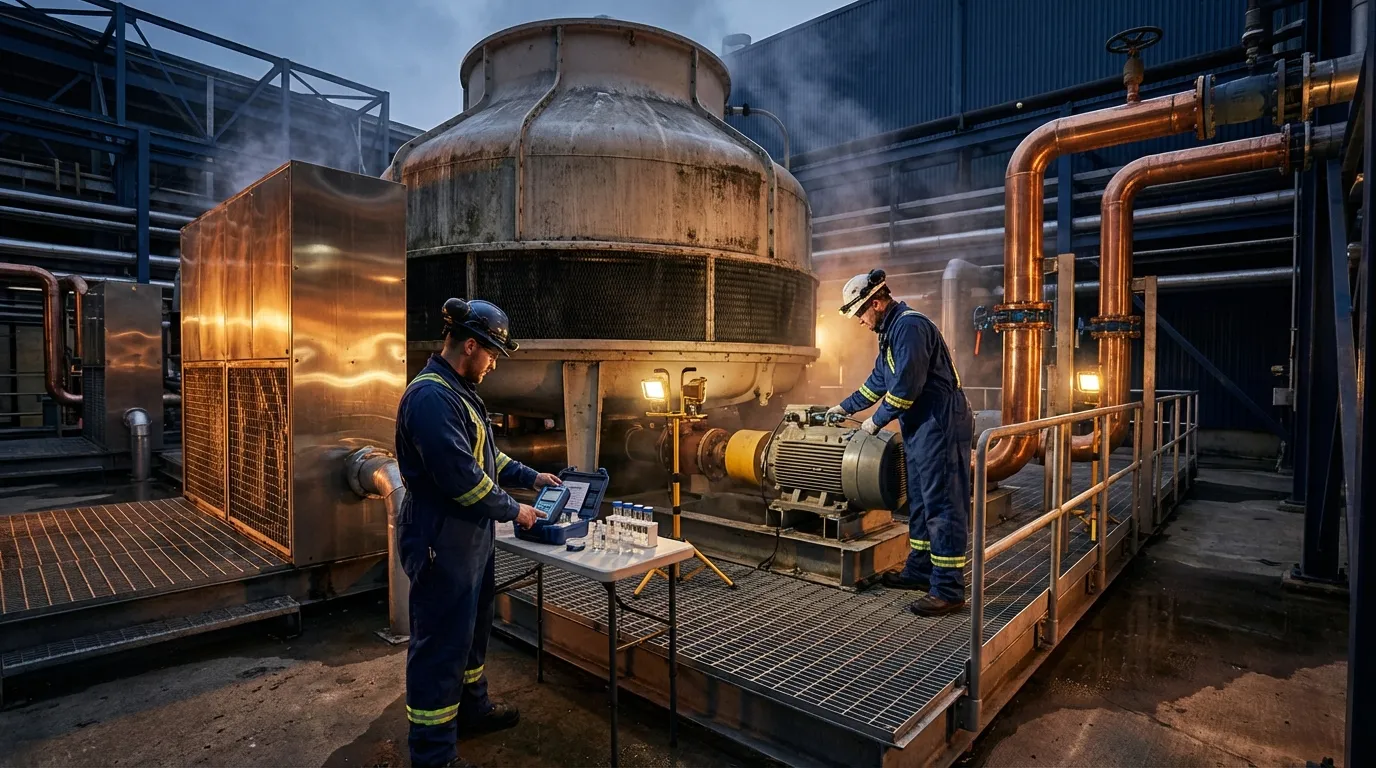
In Taiwan's high-temperature, high-humidity environment, water quality management for cooling towers is particularly important[2]:
- Water treatment: Adding scale inhibitors, corrosion inhibitors, and biocides while maintaining appropriate cycles of concentration (typically 3-5 times)
- Biofilm control: Taiwan's climate is conducive to the growth of Legionella and other microorganisms; regular biological prevention is a fundamental public health requirement
- Fill media and water distribution: Aging fill media reduces cooling efficiency; clogged water distributors cause uneven cooling
- Fans and motors: Gear reducer oil level checks, belt tension adjustment (belt-driven types), bearing lubrication
3. Continuous Monitoring of Performance Indicators
A professional maintenance plan is not just about "what work was done" but tracking "how effective was the maintenance." Core performance indicators include[3]:
- Chiller efficiency (kW/RT): Power consumed per ton of refrigeration -- lower is better. New machines typically achieve 0.5-0.7 kW/RT; degraded machines may rise to 0.8-1.0 kW/RT
- Cooling tower approach temperature: Difference between cooling water leaving temperature and outdoor wet-bulb temperature, reflecting cooling tower efficiency
- System COP: Overall system performance including chiller, pumps, and cooling tower fans
- Filter pressure differential trend: The rate of pressure differential increase reflects air quality and filter remaining life
4. Maintenance Schedule Planning
- Daily: Operating parameter inspections, abnormal sound/vibration/temperature checks
- Monthly: Filter pressure differential check, cooling water quality testing, operating log analysis
- Quarterly: Chiller performance testing, cooling tower cleaning, belt/bearing inspection
- Annually: Chiller tube bundle cleaning, comprehensive refrigerant system inspection, control system calibration
- Every 3-5 years: Compressor major overhaul, cooling tower fill media replacement assessment, comprehensive system performance diagnostic
5. Maintenance Contract Evaluation Guidelines
The quality of outsourced maintenance contracts varies greatly. When evaluating maintenance providers, owners should focus on[4]:
- Is the contract scope clearly defined: Listed maintenance items should be specific to equipment names, maintenance content, and frequency
- Performance guarantee clauses: Quality maintenance contracts should include performance indicator commitments (such as kW/RT ceiling)
- Spare parts and consumables coverage: Whether commonly used consumables such as filters, belts, and lubricating oil are included in the contract
- Emergency service response time: On-site arrival time and resolution deadlines for equipment failures
- Technician qualifications: Whether maintenance personnel hold relevant technician certificates
Conclusion
A professional maintenance plan is the insurance policy for HVAC system "health and longevity." It is not merely the routine task of changing filters and adding refrigerant, but a systematic management approach driven by performance indicators. For building owners, every dollar invested in preventive maintenance pays returns in the form of reduced energy consumption, extended equipment life, and fewer breakdowns. In the next article, we will explore the hidden science of office HVAC design that impacts employee productivity.