Refrigerant is the lifeblood of HVAC&R systems, and its selection directly determines the system's energy efficiency, safety rating, and environmental impact. Over the past three decades, the HVAC&R industry has undergone two major transitions -- from CFC to HCFC and then to HFC -- each driven by environmental regulations. Now, with the global implementation of the Kigali Amendment to the Montreal Protocol and the accelerating HFC phase-down schedules in various countries, high-GWP refrigerants represented by R-410A are being rapidly phased out. R-32, as a transitional solution balancing energy efficiency and environmental protection, has become the mainstream choice in the global air conditioning market[1]. This article systematically compares the technical differences between R-410A and R-32 from the history of refrigerant development, and analyzes the far-reaching impact of global regulatory trends on Taiwan's HVAC&R industry.
I. A Brief History of Refrigerant Development
The history of refrigerant development is essentially a story of environmental regulations and engineering technology driving each other. Every generational change in refrigerants has stemmed from the recognition and correction of the environmental hazards of the previous generation.
From the 1930s to the 1980s, chlorofluorocarbons (CFCs) were the primary refrigerants in the HVAC&R industry. R-12 was widely used in household refrigerators and automotive air conditioning, while R-11 was used in large centrifugal chillers. CFC refrigerants were considered ideal working fluids due to their non-toxic, non-flammable, and highly chemically stable properties. However, in 1974, Molina and Rowland discovered that CFCs destroy stratospheric ozone, and the 1987 Montreal Protocol formally initiated the global phase-out of CFCs[2].
After CFCs, hydrochlorofluorocarbons (HCFCs) emerged as transitional alternatives. R-22 became the world's most widely used air conditioning refrigerant, with an Ozone Depletion Potential (ODP) of only 5% of R-12, but still non-zero. The Copenhagen Amendment to the Montreal Protocol further brought HCFCs under control, requiring developing countries to complete phase-out by 2030 and developed countries even earlier by 2020[2].
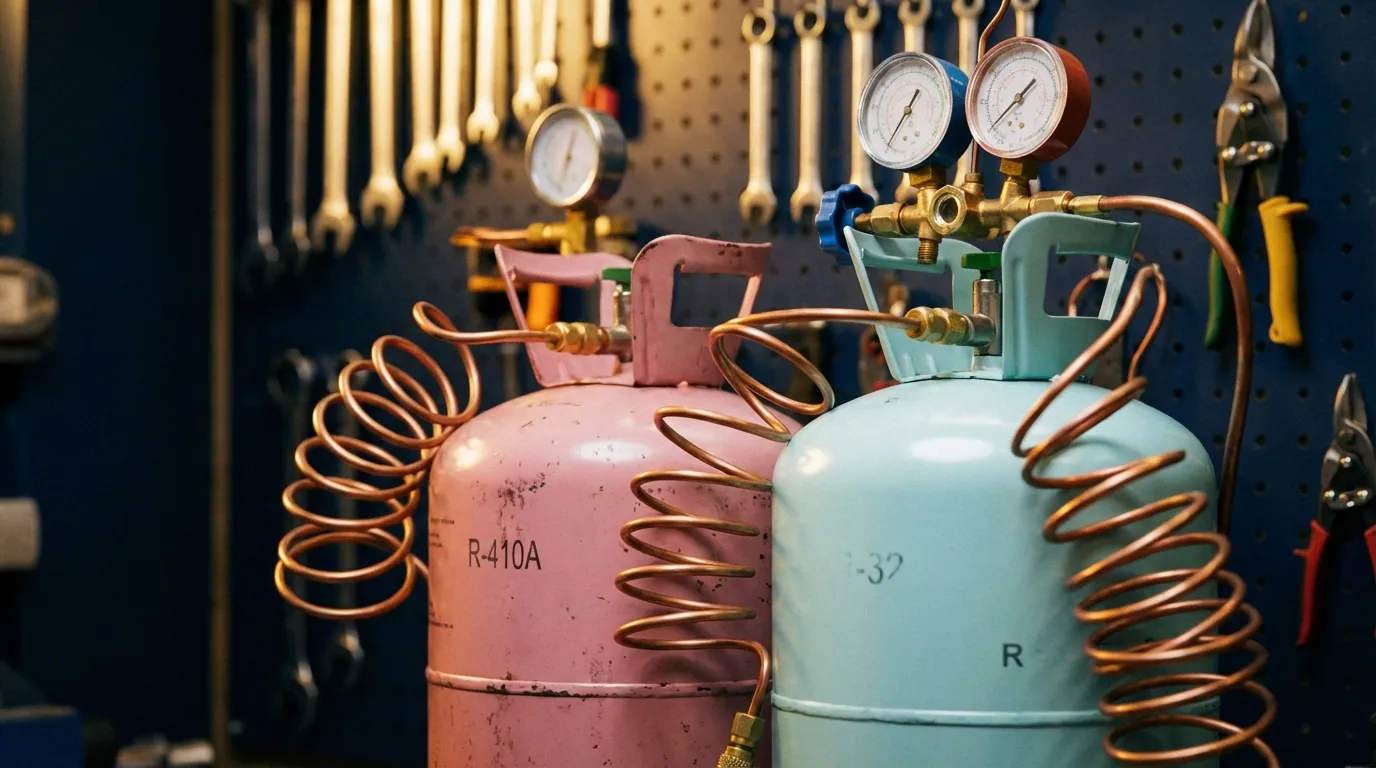
To completely solve the ozone depletion problem, hydrofluorocarbons (HFCs) emerged. R-410A -- a near-azeotropic mixture of R-32 and R-125 at a 50/50 mass ratio -- gradually replaced R-22 from the 2000s, becoming the global standard refrigerant for split and packaged air conditioners. R-410A has zero ODP, but its Global Warming Potential (GWP) is as high as 2,088[1], meaning that each kilogram of R-410A leaked into the atmosphere has a greenhouse effect equivalent to 2,088 kilograms of CO2. As global focus on greenhouse gas reduction shifted from the ozone layer to climate change, R-410A's high GWP became an unavoidable issue.
R-32 (difluoromethane, CH2F2), as one of the components of R-410A, has long been familiar to the industry. Its GWP is 675, approximately one-third that of R-410A[1]. In 2012, Daikin Industries pioneered the launch of residential split air conditioners using R-32 in the Japanese market, opening the global transition from R-410A to R-32.
II. Technical Comparison: R-410A vs. R-32
From an engineering design perspective, switching refrigerants is far more than simply "changing a fluid." R-410A and R-32 differ significantly in thermodynamic properties, system performance, safety classification, and equipment design. Design engineers must master each aspect.
Global Warming Potential (GWP)
R-410A has a GWP100 of 2,088, while R-32 has 675[1]. This means that under the same leakage volume, R-32's direct climate impact is only 32% of R-410A's. Combined with R-32 systems' lower charge requirements (detailed below), the actual carbon footprint difference is even greater. For a typical 3.5 kW residential split air conditioner, R-410A models have a typical charge of about 1.0-1.2 kg, while R-32 models require about 0.7-0.8 kg, resulting in a direct CO2 equivalent emissions difference of 3-4 times.
Energy Efficiency (COP)
R-32's Volumetric Refrigerating Capacity is approximately 4% higher than R-410A, and its theoretical COP is superior to R-410A by about 5-10% under most operating conditions[5]. This is mainly due to R-32's higher latent heat and lower pressure ratio. In actual product testing, R-32 air conditioner models from multiple manufacturers achieve 5-12% energy savings compared to corresponding R-410A models at the same cooling capacity. Combined with lower GWP, R-32 has significant advantages in LCCP (Life Cycle Climate Performance) assessments.
Refrigerant Charge
Due to R-32's higher volumetric refrigerating capacity, the refrigerant charge required to achieve the same cooling capacity is reduced by approximately 20-30% compared to R-410A[5]. The reduction in charge not only directly reduces environmental impact during leakage but also lowers refrigerant costs. For large commercial systems, the charge difference is even more significant.
Flammability Classification
R-410A's ASHRAE 34 safety classification is A1 (low toxicity, non-flammable), while R-32 is A2L (low toxicity, mildly flammable)[1]. A2L refrigerants have extremely low burning velocities (below 10 cm/s) and require relatively high minimum ignition energy, posing very limited safety risks under normal operating conditions. However, the A2L classification does impose new requirements on equipment design, installation codes, and maximum indoor charge limits. IEC 60335-2-40 (Edition 7) has established detailed safety design guidelines for A2L refrigerants, including leak detector installation, maximum charge calculation formulas, and mechanical ventilation requirements[1].
Operating Pressure and Discharge Temperature
R-32's operating pressure is similar to R-410A (condensing pressure at 40 degrees C condensing temperature is approximately 24.8 bar vs. 24.3 bar), so most R-410A system pressure ratings can be carried over to R-32. However, R-32's discharge temperature is approximately 10-20 degrees C higher than R-410A[5], which places higher demands on compressor design and lubricant temperature tolerance. Modern R-32 compressors typically use liquid injection cooling or vapor injection technology to control discharge temperature, especially during heating mode or high-pressure-ratio operation.
III. Global Regulatory Trends
The core driving force behind refrigerant transition comes from environmental regulations. Understanding global regulatory trends is essential for HVAC&R engineers' medium- to long-term planning.
Kigali Amendment
The Kigali Amendment to the Montreal Protocol, adopted in 2016, is the third major milestone in global refrigerant regulation following the CFC and HCFC phase-outs[2]. The Kigali Amendment brings HFCs under regulatory control, with different phase-down schedules based on each country's development stage:
- Developed Countries (A2 Group): Using 2011-2013 as the baseline, reductions begin in 2019, reaching 15% of the baseline by 2036
- Most Developing Countries (A5-I Group): Using 2020-2022 as the baseline, freeze in 2024, reductions begin in 2029, reaching 20% of the baseline by 2045
- Some Developing Countries (A5-II Group, including India, Pakistan, etc.): Using 2024-2026 as the baseline, freeze in 2028, reductions begin in 2032, reaching 15% of the baseline by 2047
As of the end of 2025, over 150 countries have ratified the Kigali Amendment[2]. This means the global HFC phase-down has moved from policy declarations to substantive implementation.
EU F-Gas Regulation
The EU leads the world in HFC regulation. The newly revised Regulation (EU) 2024/573[3] (replacing EU No 517/2014) significantly tightened HFC reduction targets and equipment bans:
- From January 1, 2025: Ban on refrigerants with GWP >= 750 in new split air conditioning systems (unit charge < 3 kg)
- From January 1, 2027: Ban on refrigerants with GWP >= 150 in new split air conditioning systems (unit charge < 3 kg)
- From January 1, 2032: Ban on refrigerants with GWP >= 150 in all new stationary air conditioning systems
- From January 1, 2050: Complete ban on HFC production and import
Notably, the 2027 GWP 150 threshold means R-32 (GWP 675) will only be applicable in the EU small split air conditioning market until the end of 2026. The EU market is accelerating its shift toward R-290 (propane, GWP approximately 3) and R-454B (GWP 466) and other lower GWP alternatives[3].
U.S. AIM Act
The American Innovation and Manufacturing Act (AIM Act), passed in 2020, authorizes the EPA to reduce HFC production and consumption to 15% of the 2011-2013 baseline by 2036[4]. The EPA has issued technology transition rules for specific equipment categories:
- From January 1, 2025: New residential and light commercial air conditioning systems are prohibited from using refrigerants with GWP >= 700; R-410A officially exits the U.S. new residential air conditioning market
- R-454B (trade name Opteon XL41, GWP 466) becomes the primary alternative to R-410A in the U.S. market
The U.S. market chose R-454B rather than R-32 as the primary replacement refrigerant, mainly considering its lower GWP and better regulatory forward-compatibility[4]. However, R-454B is a blend of R-32 and R-1234yf, and its supply chain stability and cost remain industry concerns.
Japan's Pioneering Experience
Japan is the world's first market to adopt R-32 air conditioning on a large scale. Since Daikin launched the first R-32 residential air conditioner in 2012, the Japanese market completed the full transition of residential air conditioners from R-410A to R-32 within just five years. According to statistics from the Japan Refrigeration and Air Conditioning Industry Association (JRAIA), as of 2023, nearly 100% of residential split air conditioners sold in Japan use R-32[6]. Japan's success demonstrates the feasibility of the R-32 transition at both the technical and market levels, providing an important reference for other Asia-Pacific markets.
Taiwan's Regulatory Developments
Although Taiwan is not a signatory to the Montreal Protocol, it continues to align with international standards in refrigerant management. The Bureau of Standards, Metrology and Inspection (BSMI) under the Ministry of Economic Affairs has incorporated R-32 models into its air conditioner energy efficiency testing and labeling standards (CNS standards)[7]. Additionally, the Ministry of Environment's greenhouse gas regulations also list HFCs as controlled substances. As international manufacturers fully shift to R-32, Taiwan's market refrigerant transition is effectively accelerating.
IV. Taiwan's HVAC&R Industry Response
Facing the global refrigerant transition wave, Taiwan's HVAC&R industry response strategy needs to advance simultaneously from equipment, design, and service perspectives.
Equipment Market Status
As of 2025, the proportion of R-32 models in Taiwan's residential split air conditioner market has increased significantly. Major brands including Daikin, Panasonic, LG, Mitsubishi Electric, and Hitachi have all made R-32 the primary refrigerant for their residential product lines[6]. In the commercial air conditioning sector, the transition of VRF (Variable Refrigerant Flow) systems to R-32 is also underway. Daikin and Mitsubishi Electric have launched R-32 VRF models, but due to the larger refrigerant charges in commercial systems, the A2L safety requirements are more stringent, and the transition progress is slower than in the residential market.
Impact on Design Engineers
The adoption of R-32 brings the following practical impacts for HVAC&R design engineers:
- Indoor Charge Limits: According to IEC 60335-2-40 and local regulations, the maximum indoor charge of A2L refrigerants must be calculated based on room area and installation height. Design engineers must verify that each indoor unit's refrigerant charge does not exceed the safety limit for that space
- Leak Detection and Ventilation: A2L refrigerant systems must be equipped with refrigerant leak detectors and must activate mechanical ventilation or shut off refrigerant supply when a leak is detected. This adds complexity and cost to system design
- Piping Materials and Welding: R-32 and R-410A have similar operating pressures, so existing copper pipe specifications can mostly be carried over. However, due to R-32's higher discharge temperature, the material selection and welding quality of high-pressure side piping are more critical
- Refrigeration Oil Compatibility: R-32 systems generally use POE (Polyolester) refrigeration oil, the same as R-410A systems, but due to the discharge temperature difference, the oil's temperature tolerance specifications must be verified
Maintenance and Retrofit Issues
Existing R-410A systems cannot be directly recharged with R-32. Although the two are similar in pressure, there are differences in compressor design, expansion valve specifications, refrigeration oil viscosity, and electronic control logic. Leak repairs and refrigerant top-ups for R-410A equipment currently still use R-410A, but as HFC quota systems progressively tighten, R-410A supply and pricing will face significant changes over the next decade. Design engineers should prioritize R-32 or lower GWP refrigerant solutions in new construction projects, avoiding risks of refrigerant procurement difficulties for building owners during the equipment lifecycle.
V. Natural Refrigerants and Next-Generation Options
While R-32 is the most pragmatic transitional solution currently available, from a long-term environmental perspective, GWP 675 is not the final destination. The EU's 2027 GWP 150 threshold already points to the next phase -- natural refrigerants and ultra-low GWP synthetic refrigerants[8].
R-290 (Propane)
R-290 is a hydrocarbon refrigerant with a GWP of only approximately 3, zero ODP, and excellent thermodynamic properties and energy efficiency. R-290 already has mature applications in small split air conditioners and commercial refrigerated display cases in Europe. Its greatest challenge is the A3 classification (highly flammable), which strictly limits indoor charge (IEC 60335-2-40 specifies a maximum charge per indoor unit of approximately 988 g), and requires compliance with ATEX and other explosion-proof design requirements[1]. For medium and large commercial air conditioning systems, R-290's flammability limitations remain a difficult hurdle to overcome.
R-744 (CO2)
The history of carbon dioxide (CO2) as a refrigerant dates back to the 19th century. It has a GWP of 1 and zero ODP. R-744 operates in a transcritical cycle with extremely high system pressures (high-pressure side can exceed 100 bar), requiring specialized high-pressure equipment. R-744 is increasingly applied in supermarket refrigeration, heat pump water heaters, and industrial refrigeration, but its application in comfort air conditioning remains limited by high-pressure equipment costs and system efficiency degradation at high ambient temperatures[8].
R-717 (Ammonia)
Ammonia is one of the oldest refrigerants, with a GWP of 0, zero ODP, excellent energy efficiency, and low cost. R-717 is the traditional first choice for large industrial refrigeration systems (food processing, cold storage). Its limitation is the B2L classification (higher toxicity, mildly flammable), making it unsuitable for comfort air conditioning in densely occupied spaces, and system design must comply with strict safety regulations (such as IIAR standards)[8].
R-454B
R-454B (Opteon XL41) is a blend of R-32 (68.9%) and R-1234yf (31.1%), with a GWP of 466 and ASHRAE safety classification A2L[5]. R-454B is the primary solution replacing R-410A in the U.S. market. Its operating pressure is close to R-410A, facilitating platform-based equipment design. However, R-454B is a zeotropic mixture with a temperature glide of approximately 1.5 degrees C, and the supply and pricing of the R-1234yf component are potential bottlenecks for market adoption.
Conclusion
From CFC to HCFC, from HCFC to HFC, each refrigerant transition in the HVAC&R industry has taken ten to twenty years. Now, the third transition from high-GWP HFCs to low-GWP alternatives has been fully launched. R-32, with its relatively lower GWP, excellent energy efficiency, and mature manufacturing technology, is the most pragmatic and feasible transitional solution. But looking further into the future, natural refrigerants and ultra-low GWP synthetic refrigerants will each find their place in different application areas. As HVAC&R engineering professionals, we must closely monitor the evolution of global regulations and incorporate the environmental impact and long-term availability of refrigerants into systematic consideration in every new project's design decisions -- this is not only an obligation of regulatory compliance but also an engineering ethics responsibility to the next generation.