"How much does a central AC system cost?" This is the most common -- and hardest to precisely answer -- question building owners ask. HVAC project costs are influenced by system type, equipment specifications, building conditions, and construction complexity among multiple factors. Making investment decisions based solely on rough "cost per square meter" estimates often leads to budget overruns or underperforming systems in later project stages. This article systematically breaks down the structural components of HVAC project costs from a professional engineering consultant's perspective, and introduces the Life-Cycle Cost (LCC) concept to help building owners establish a proper investment assessment framework.
1. Structural Components of HVAC Project Costs
A complete HVAC project cost is not simply equipment procurement expenses but comprises multiple cost items. Based on construction cost reference data and practical experience[1], the cost structure of large-scale HVAC projects is roughly estimated as follows:
- Equipment cost (35-45%): Procurement costs for core equipment including chillers, AHUs, cooling towers, pumps, VRF outdoor/indoor units. This is the single highest-proportion item in the cost structure
- Material cost (15-20%): Construction materials including refrigerant piping, chilled water piping, ductwork, insulation, valves, hangers and supports
- Construction cost (20-25%): Including installation labor, pipe welding, duct fabrication and installation, equipment rigging, system testing and balancing (TAB), and other labor costs
- Design and supervision fees (6-10%): Design and supervision service fees for engineering firms or consultants, varying by project scale and complexity[2]
- Management fees and profit (8-12%): Indirect costs including project management, insurance, quality control, and contractor profit
Many building owners initially focus only on equipment quotes, overlooking that material and construction costs often account for 35-45% of total project cost. If a contractor uses low-priced equipment with inferior materials or compressed construction quality to lower quotes, the owner may save on initial costs but pay a higher price in future maintenance and energy consumption.
2. Cost Ranges for Major Equipment
Chillers
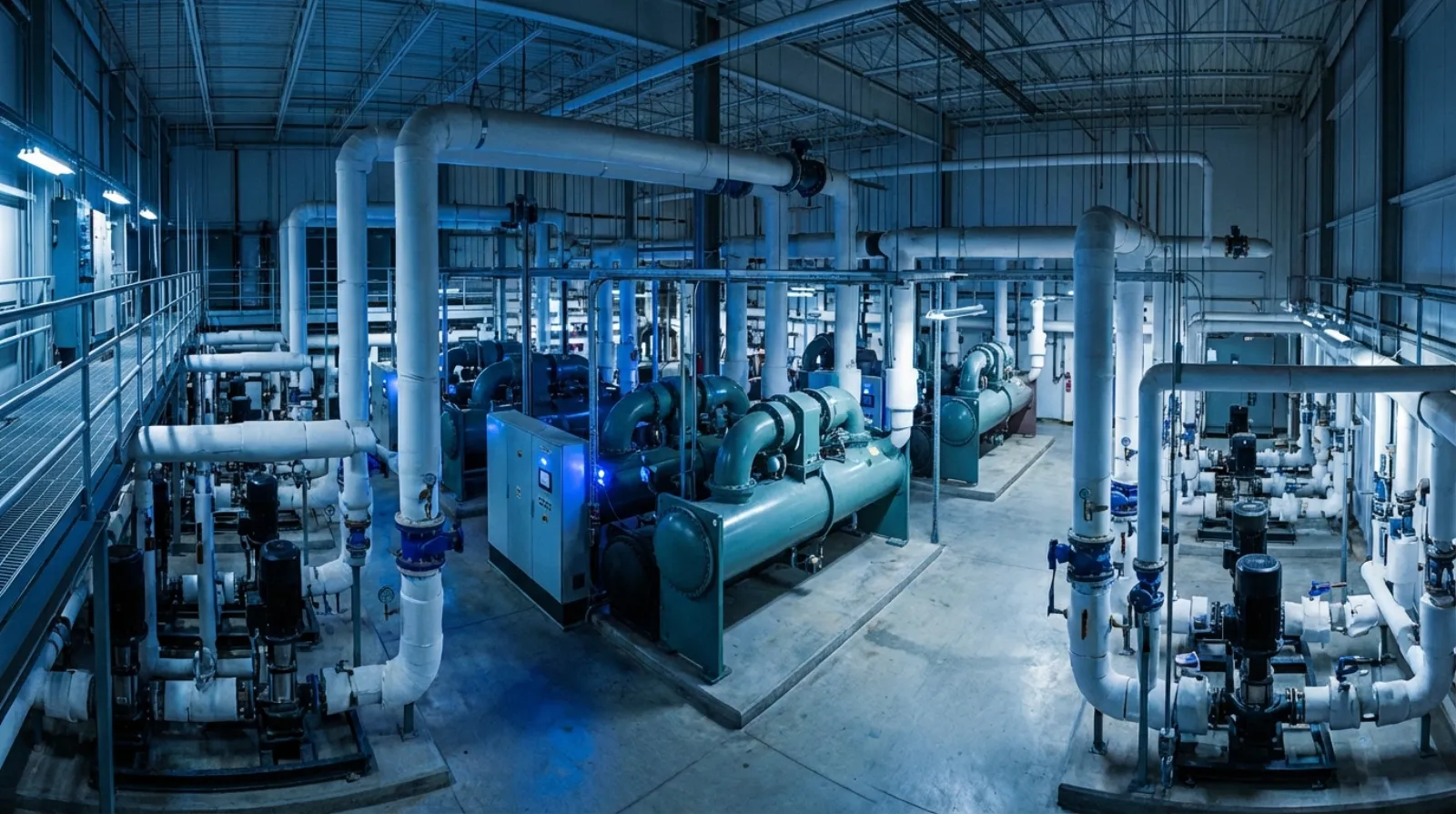
Chillers are the single most expensive piece of equipment in central AC systems, with prices heavily influenced by compressor type, cooling method, and capacity[3]:
- Air-cooled screw (50-150 RT): Approximately NT$8,000-12,000 per RT. Easy installation, no cooling tower needed, suitable for small to medium systems
- Water-cooled screw (100-500 RT): Approximately NT$6,000-10,000 per RT. Higher energy efficiency than air-cooled, the workhorse of medium to large systems
- Water-cooled centrifugal (300-2,000 RT): Approximately NT$5,000-8,000 per RT. Lowest unit cost at large capacity, full-load COP can exceed 6.0
- Magnetic bearing centrifugal (200-1,500 RT): Approximately NT$8,000-14,000 per RT. Oil-free design with excellent part-load efficiency, suitable for projects pursuing long-term energy savings
VRF/VRV Multi-Split Systems
VRF system costs are typically estimated as total system cost per ton (per RT), including outdoor units, indoor units, refrigerant piping, and controllers. Depending on brand and configuration, total system cost per RT is approximately NT$25,000-40,000[4]. Japanese brands (Daikin, Hitachi, Mitsubishi Electric) typically occupy the mid to high end of the price range, while Korean and Chinese brands are relatively lower.
AHUs and Fan Coil Units
- AHU (2,000-30,000 CFM): Approximately NT$150,000-800,000 per unit depending on airflow and features. Units with total energy recovery, HEPA filtration, and other special specifications command higher prices
- Fan Coil Unit (FCU): Concealed horizontal type approximately NT$8,000-20,000 per unit, depending on airflow and brand
Cooling Towers
Open counterflow cooling towers cost approximately NT$1,500-3,000 per RT. Closed-circuit cooling towers cost approximately 2-3 times that of open types but offer better water quality management and lower maintenance costs[5].
Pumps and Ductwork
- Chilled water pumps: Approximately NT$50,000-300,000 per unit depending on flow rate and head. VFD pumps carry a premium of approximately 20-30%
- Galvanized steel ductwork: Approximately NT$800-1,500 per square meter of developed area (including fabrication and installation)
BMS Automatic Control Systems
Building Management System (BMS) costs vary greatly, from basic DDC controllers with temperature/humidity sensors (approximately 5-8% of total HVAC project cost) to complete BAS systems integrating energy management, fault diagnostics, and cloud monitoring (up to 10-15%), depending on the owner's management requirements[6].
3. Per-Unit-Area Cost Comparisons by System Type
System Type Cost Comparison
The following are approximate per-ping cost ranges for three major HVAC system types across different building types (including equipment, materials, and construction, excluding design and supervision fees):
- Split AC systems: Approximately NT$3,000-6,000 per ping. Suitable for small offices and retail spaces, quick installation but limited economies of scale
- VRF multi-split systems: Approximately NT$6,000-12,000 per ping. Mainstream choice for mid-size office buildings and hotels, flexible piping and convenient individual metering
- Chilled water systems: Approximately NT$8,000-18,000 per ping. Standard for large commercial offices, hospitals, and factories; higher initial investment but lower long-term operating costs
Typical Costs by Building Type
- Office buildings (1,650-10,000 m2): VRF systems NT$7,000-10,000 per ping; chilled water systems NT$10,000-14,000 per ping
- Technology fabs (process HVAC): NT$15,000-30,000+ per ping, significantly higher due to cleanliness requirements, precision temperature/humidity control, and 24-hour operation
- Hotels: NT$8,000-15,000 per ping, due to coexisting individual guest room control and large public area HVAC needs
- Hospitals: NT$12,000-25,000 per ping, due to operating room positive pressure control, infection control zoning, and backup system requirements[7]
Key Variables Affecting Costs
The above costs are approximate references only. Actual costs are significantly affected by:
- Number of floors and building height: High-rise buildings' pipe pressure requirements, equipment rigging difficulty, and intermediate mechanical room configuration can increase costs by 10-20%
- Piping distance: The longer the piping from the chiller to the most remote terminal equipment, the greater the piping and insulation material quantities, and the higher the pump head requirements
- Special requirements: Such as constant temperature/humidity, cleanroom classifications, high-redundancy design (N+1 backup), special refrigerants (CO2, NH3), etc., all significantly increase costs
- Existing building renovation vs. new construction: Existing building HVAC renovation projects typically cost 15-30% more than new construction due to demolition, structural constraints, and non-disruptive construction requirements
4. Life-Cycle Cost (LCC) Analysis: The True Basis for Investment Decisions
Initial cost is just the tip of the iceberg for total HVAC system investment. According to ASHRAE research[8], initial investment accounts for only 25-35% of total cost of ownership over a 20-year HVAC system lifecycle, while energy costs and maintenance during operation account for 65-75%. This means choosing a system with lower initial cost but inferior energy efficiency ends up costing more in the long run.
LCC Components
- Capital Cost: One-time expenditure for equipment, materials, construction, and design supervision, approximately 25-35% of LCC
- Energy Cost: Cumulative 20-year electricity costs, the single largest item in LCC, approximately 40-55%
- Maintenance Cost: Annual maintenance, parts replacement, system inspections, approximately 10-15% of LCC
- Replacement Cost: Major component replacements (such as compressors, motors) during service life, approximately 5-10%
- Residual Value: Remaining equipment value at end of service life, typically deducted as a negative value in calculations
LCC Example: 100 RT Chilled Water vs. VRF System
For a 5,000 m2 office building (design load 100 RT), assuming 2,500 annual operating hours, NT$4.5/kWh electricity rate, 3% discount rate, comparing 20-year LCC of two systems:
- Chilled water system: Initial investment approximately NT$15 million, average annual electricity consumption approximately 250,000 kWh (system average COP 4.5), annual maintenance approximately NT$450,000. 20-year LCC approximately NT$45 million
- VRF system: Initial investment approximately NT$12 million, average annual electricity consumption approximately 290,000 kWh (system average COP 3.8), annual maintenance approximately NT$350,000, but requires outdoor unit compressor module replacement at year 13 of approximately NT$2.5 million. 20-year LCC approximately NT$48 million
In this example, despite the chilled water system's initial investment being NT$3 million higher, its higher energy efficiency and longer equipment life result in a 20-year LCC approximately NT$3 million lower than the VRF system. Of course, this is an estimate under specific conditions, and actual results will vary by usage patterns, electricity rates, and maintenance quality.
Reasonable Budget for Maintenance Costs
Per industry practice and ASHRAE recommendations, annual HVAC system maintenance costs should be budgeted at 2-4% of initial equipment investment. Insufficient maintenance budgets lead to premature equipment aging, energy efficiency degradation, and ultimately higher energy costs and premature equipment replacement.
Need a customized cost assessment and LCC analysis for your project? Contact our engineering team for an independent, objective engineering investment assessment report.
5. Engineering Strategies for Reducing Total Cost of Ownership
Accurate Load Calculation to Avoid Oversizing
Equipment oversizing is the most common cause of excessive costs and low operating efficiency. Many contractors habitually enlarge design loads by 30-50% citing "safety factors," causing equipment to operate at low load long-term, wasting both initial investment and reducing system COP. Accurate load calculations should follow ASHRAE Handbook -- Fundamentals methods[9], considering building envelope thermal performance, internal heat gains, occupancy density, and usage schedules. A reasonable safety factor should not exceed 10-15%.
Payback Period for High-Efficiency Equipment Premium
Choosing high-efficiency equipment typically requires a 15-30% initial premium. Using magnetic bearing centrifugal chillers as an example, with a per-RT premium of approximately NT$3,000-5,000 over conventional screw chillers, annual electricity savings benefit of approximately NT$1,500-2,500 per RT, the premium can be recovered in 2-3 years. For buildings with high annual operating hours (such as hospitals, data centers), the payback period is even shorter.
Quantifying VFD Energy Savings
Variable Frequency Drives (VFD) applied to chilled water pumps and cooling tower fans dynamically adjust speed based on actual load. According to pump affinity laws, a 20% reduction in flow reduces power consumption by approximately 49%. Under Taiwan's typical office building usage patterns with approximately 50-60% annual average HVAC load rate, implementing a full-VFD water-side system can save 30-50% of water-side energy, achieving approximately 15-25% overall system energy savings[10].
Value Engineering (VE) During Design Phase
Value Engineering optimizes design solutions to reduce costs without sacrificing functional requirements. Common VE strategies include:
- Duct system routing optimization, reducing elbows and transitions to lower duct material quantities and fan static pressure requirements
- Chilled water system temperature differential optimization (such as large delta-T design of 7-8 deg C), enabling smaller pipe diameters and pump capacities
- Rational equipment room layout, shortening piping distances and reducing pump head
- Standardization of terminal equipment specifications, reducing model variety to lower procurement and spare parts costs
6. The Value of Engineering Consultants in Cost Control
Design Review to Prevent Improper Specifications
Independent engineering consultants do not represent any equipment brand and can review design specification reasonableness from a neutral standpoint. Common cost wastes include: oversized equipment capacity, unnecessarily high specifications (such as non-essential full-VFD configurations), and stacked safety factors. Experienced engineers through design review can typically reduce 10-20% of unnecessary costs without sacrificing system performance.
Independent Cost Estimation and Market Intelligence
Independent estimates and detailed cost analyses prepared by engineering consultants before bidding serve as important references for owners to judge bid price reasonableness. Through long-term accumulated project databases and equipment market intelligence, consultants can identify abnormal bid items -- whether overpriced (possible excessive profit) or underpriced (possible corner-cutting risks).
Alternative Comparison and Optimization Recommendations
During the early design phase, engineering consultants can propose multiple system options and conduct technical-economic comparative analysis, helping owners achieve the optimal balance between function, quality, cost, and long-term operating expenses. The value generated by "multi-option comparison during the design phase" far exceeds the consulting fee itself -- because the cost of changing plans after design finalization is typically 5-10 times that of the design phase.
Conclusion
HVAC project costs should not be judged solely by the level of initial quotes but should use 20-year life-cycle total cost of ownership as the basis for investment decisions. Accurate load calculation, reasonable equipment selection, efficient system design, and professional cost management are the four keys to controlling total cost of ownership. Engaging independent engineering consultants for cost analysis and option comparison during the design phase is the most effective strategy for owners to ensure investment returns. A truly good HVAC project is not the one that costs the most, but one where every dollar invested continuously generates value returns throughout its 20-year service life.