HVAC systems account for 40-60% of total building energy consumption, with 15-30% of energy waste attributed to undetected equipment faults and performance degradation[1]. Traditional reactive maintenance intervenes only after equipment failure, while preventive maintenance replaces parts on fixed schedules -- neither can precisely assess the true health status of equipment. With the maturation of IoT sensors, digital twins, and AI Agent technologies, HVAC operations and maintenance is entering its fourth-generation paradigm: AI agents that autonomously detect anomalies, diagnose root causes, predict remaining useful life, and generate maintenance recommendations. This article systematically deconstructs the implementation pathway from digital twins to Fault Detection and Diagnostics (FDD) from a systems engineering perspective, while exploring AI transformation opportunities for Taiwan's HVAC maintenance industry.
1. Four Generations of HVAC Maintenance Paradigms
HVAC system maintenance strategies have evolved through four distinct generations, each representing an increasingly sophisticated answer to the core question of "when to maintain."
First Generation: Reactive Maintenance (Run-to-Failure)
Fix it when it breaks. This is the most primitive and most expensive model. When a centrifugal chiller shuts down due to bearing wear, emergency repair costs are typically 3-5 times those of planned maintenance, not to mention the impact on building operations and tenant comfort during downtime. According to U.S. Department of Energy (DOE) statistics, reactive maintenance costs are 30-40% higher than preventive maintenance[2].
Second Generation: Time-Based Preventive Maintenance
Perform maintenance at fixed intervals based on manufacturer recommendations or rules of thumb. For example, cleaning condenser coils quarterly, replacing cooling tower fill annually, and changing compressor oil every two years. This model reduces unexpected downtime risk but has two fundamental problems: over-maintenance (replacing parts when equipment is still in good condition) and under-maintenance (failures occurring between maintenance intervals that go undetected).
Third Generation: Condition-Based Monitoring
Continuously monitor key equipment parameters (vibration, temperature, current, pressure) through sensors, issuing alerts when values deviate from normal ranges. This is more precise than fixed schedules but still relies on manually set thresholds and rules, with limited detection capability for slowly developing soft faults -- such as gradual coil fouling or minor refrigerant leaks.
Fourth Generation: AI-Agent Predictive Maintenance
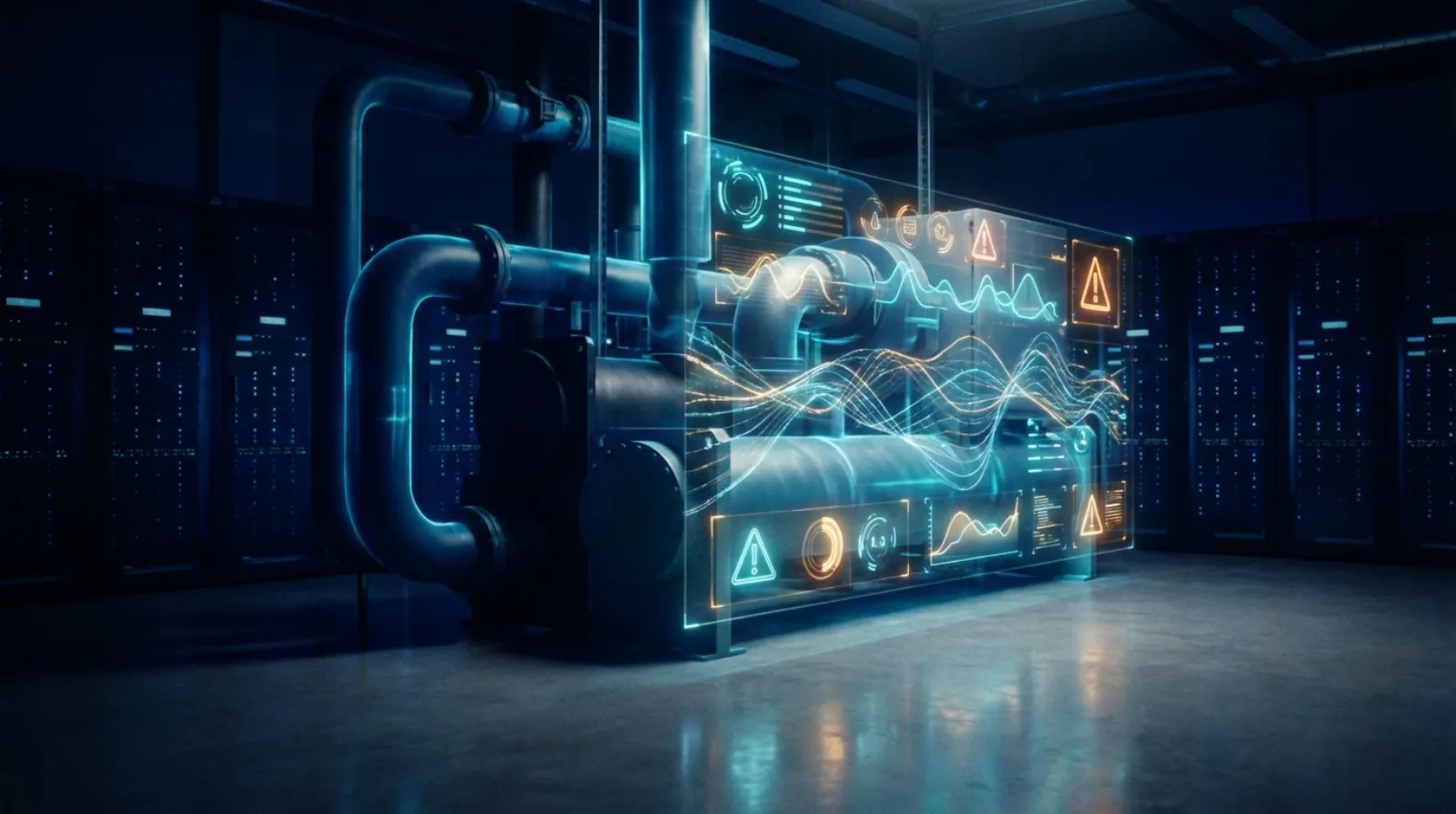
Combining digital twins, machine learning, and AI Agent architecture, the system not only monitors current status but predicts future trends. AI Agents can autonomously analyze multi-dimensional sensor data, compare expected behavior from digital twins against actual operational deviations, identify fault patterns, predict remaining useful life (RUL), and provide specific maintenance recommendations in natural language to O&M teams[3]. This represents the critical leap from "data-driven" to "decision-driven."
2. Digital Twins: The Foundation of HVAC Predictive Maintenance
A digital twin is a dynamic virtual replica of physical equipment in digital space that not only replicates the static geometry and parameters of equipment but continuously synchronizes operational status, performance metrics, and environmental conditions through real-time data streams. In the HVAC domain, digital twins provide an irreplaceable "reference baseline" for fault detection.
Hierarchical Architecture of HVAC Digital Twins
A complete HVAC digital twin system typically encompasses three levels:
- Component-Level Digital Twin: Physical models built for individual equipment, such as isentropic efficiency models for centrifugal compressors, NTU heat exchange models for cooling towers, and mixed-air and coil heat transfer models for air handling units (AHUs). These models are based on equipment design parameters and calibrated with real-time measurement data[4]
- System-Level Digital Twin: Multiple component models connected into complete chilled water or HVAC system loops, such as the closed-loop model of chiller to chilled water pump to AHU to return water piping. System-level twins capture inter-equipment interactions -- such as the cascading effect of cooling tower performance degradation leading to elevated condenser pressure in the chiller
- Building-Level Digital Twin: Integrating building envelope thermal load models, internal heat sources (occupants, lighting, equipment), and weather forecast data to predict cooling load demand 24-72 hours into the future, providing load context for maintenance scheduling
The Core Role of Digital Twins in Fault Detection
The core value of digital twins lies in providing a reference baseline for "expected behavior." In the AHU digital twin predictive maintenance framework proposed by Lu et al. (2022), the system continuously compares actual operational data against the digital twin model's predicted output, flagging anomalous conditions when residuals exceed statistical thresholds[5]. This model-residual-based approach is more sensitive than traditional fixed-threshold alarms, capable of issuing early warnings when performance deviation is only 5-10%.
Taking a chiller as an example: when the digital twin model predicts that evaporating pressure should be 4.2 bar under current cooling water inlet temperature and load conditions, but the actual measurement consistently reads 3.8 bar, the 0.4 bar residual has not yet triggered the chiller's own low-pressure protection (typically set at 2.5-3.0 bar) but clearly points to insufficient refrigerant charge or deteriorated evaporator heat transfer.
3. AI Agent Architecture: From Fault Detection to Autonomous Diagnostics
Traditional Fault Detection and Diagnostics (FDD) systems mostly employ rule-based engines or single machine learning models. AI Agent architecture elevates FDD to "autonomous reasoning and decision-making" -- multiple specialized Agents each handle their own responsibilities, collaborating to complete the entire workflow from data ingestion and anomaly detection to root cause analysis and maintenance recommendation generation.
Multi-Agent System Architecture
Nunes et al. (2023) proposed using multi-agent systems to implement distributed intelligence for maintenance decisions in their AI Agent predictive maintenance conceptual framework[3]. Applied to the HVAC domain, a typical multi-agent FDD system may include the following Agents:
- Data Ingestion Agent: Responsible for collecting real-time data from BMS/BAS systems, IoT sensors, and weather APIs, performing data cleaning, missing value imputation, and time alignment
- Anomaly Detection Agent: Continuously monitors operational deviations of each piece of equipment using digital twin residual analysis, statistical process control (SPC), or unsupervised learning (such as Isolation Forest, Autoencoder)
- Fault Diagnosis Agent: When the Anomaly Detection Agent raises an alert, the Fault Diagnosis Agent initiates root cause analysis, using classification models (such as Random Forest, XGBoost) or Bayesian networks to match against known fault pattern libraries, outputting fault type and confidence level
- Prognostics Agent: Based on fault development trends and historical degradation curves, estimates equipment remaining useful life (RUL) and optimal maintenance time windows
- Decision Agent: Synthesizes fault severity, maintenance resource availability, spare parts inventory, and load scheduling to generate prioritized maintenance work order recommendations
- Communication Agent: Delivers diagnostic results and recommendations to O&M personnel through a natural language interface, responding to follow-up questions and clarifications
LLM-Enhanced FDD: OpenClaw and Natural Language Interfaces
Large Language Models (LLMs) bring a revolutionary user interface paradigm to HVAC FDD. Traditional FDD systems output fault codes, numerical reports, or rule trigger logs that require senior engineers to correctly interpret. LLM-driven Agents can translate these technical outputs into natural language recommendations that O&M personnel can directly understand and act upon[6].
Take OpenClaw as an example -- an open-source building energy and controls intelligent agent framework that integrates LLM natural language understanding with building systems domain knowledge. O&M personnel can ask in natural language: "Why is the supply air temperature of AHU No. 3 higher than the setpoint by 2 degrees C?" The Agent automatically queries relevant sensor data, compares against the digital twin model, retrieves historical fault records, and ultimately responds in structured natural language: "The chilled water coil outlet temperature of AHU No. 3 is 3.1 degrees C above normal. The chilled water control valve may be stuck at 62% open position. Recommend inspecting the actuator stroke of V-AHU03-CW"[6].
The value of this natural language interface extends beyond lowering the barrier to use -- it bridges the gap between "AI output" and "human decision-making." O&M personnel no longer need to understand the internal logic of machine learning models; they only need to evaluate the reasonableness of recommendations and decide whether to execute them.
4. Key HVAC Fault Types and AI Detection Methods
HVAC system faults can be categorized as hard faults and soft faults. Hard faults, such as compressor seizure or fan belt breakage, typically trigger immediate shutdown protection. The real test of AI FDD capability is soft faults -- they develop slowly, gradually worsen, and traditional monitoring systems often detect them only after performance has significantly deteriorated.
Refrigerant Leak Detection
Refrigerant leaks are one of the most common and costly soft faults in chillers. According to ASHRAE statistics, commercial HVAC systems leak an average of 2-10% of their refrigerant charge annually[7]. When refrigerant is 10% below the rated charge, system COP may have already dropped 8-15%, yet operators often cannot identify obvious anomalies from temperature and pressure gauges.
AI detection methods employ multivariate correlation analysis: tracking micro-trends in evaporating pressure, superheat, and compressor current under identical cooling water inlet temperature, chilled water outlet temperature, and load conditions. Digital twin models can precisely quantify the "expected evaporating pressure for normal refrigerant charge under current operating conditions," and the residual trend against actual measurements serves as an early indicator of leakage.
Coil Fouling and Heat Transfer Degradation
Chilled water coils in AHUs and condenser coils gradually foul during extended operation, reducing the heat transfer coefficient (UA value). ASHRAE RP-1312 research indicates that coil fouling can reduce AHU cooling capacity by 10-25% while increasing air-side pressure drop[8].
AI detection methods continuously estimate the real-time UA value of coils -- based on inlet/outlet temperatures and flow data, using the epsilon-NTU method to back-calculate heat transfer performance. When the sliding average of the UA value drops below 80% of the baseline, the system can issue a coil cleaning recommendation and predict when, at the current fouling rate, indoor temperature control capability will be affected.
Control Valve Sticking
Chilled water control valve sticking (Stuck Valve) is one of the most common control faults in AHU systems. Valves may be completely stuck, partially stuck, or exhibit hysteresis. A stuck control valve prevents the AHU from properly regulating chilled water flow, causing supply air temperature to deviate from setpoints, increasing energy consumption, or reducing comfort.
AI detection methods analyze the dynamic relationship between control signals and valve position feedback (if available) or downstream temperature response. A normal valve should produce a corresponding temperature response within 30-120 seconds of a control signal change; a stuck valve exhibits dead band, step-like, or completely unresponsive characteristics. Research by Zhao et al. (2023) showed that LSTM network-based valve condition monitoring achieves 92% detection accuracy within 72 hours of sticking onset[4].
Sensor Drift
Sensor drift is a hidden challenge for FDD systems -- when the sensors used to detect faults themselves develop biases, all downstream analyses become contaminated. Temperature sensor annual drift is typically plus or minus 0.1-0.5 degrees C but may accelerate in high-temperature, high-humidity environments.
AI detection methods employ virtual sensor technology: using system physical models or data-driven models to infer the expected value of a sensor from other correlated measurements. When the deviation between actual measurements and virtual sensor values continuously expands, sensor drift can be identified, and the system automatically switches to virtual sensor values to maintain FDD system reliability.
Cooling Tower Performance Degradation
Cooling tower performance is affected by multiple factors including fill media aging, scale deposits, uneven water distribution, and fan efficiency degradation. Performance degradation directly elevates cooling water return temperature, increasing chiller condenser pressure and energy consumption.
AI detection methods continuously track the cooling tower's approach temperature -- the difference between cooling water outlet temperature and inlet air wet-bulb temperature. Under identical water-to-air ratio (L/G ratio) and weather conditions, a trending increase in approach temperature is a direct indicator of performance degradation.
5. RAG Technology: Intelligent O&M Knowledge Bases
Retrieval-Augmented Generation (RAG) is the key technology that gives LLM Agents domain expertise. In the context of HVAC predictive maintenance, RAG digitizes and structures the decades of experiential knowledge accumulated by O&M teams, supplying it to AI Agents in real-time as reference material for diagnostic reasoning[9].
O&M Knowledge Base Content Sources
A complete HVAC O&M knowledge base should encompass the following document types:
- Equipment Operation Manuals: Installation, operation, and maintenance manuals for various brands of chillers, AHUs, and cooling towers, including fault code reference tables and troubleshooting flowcharts
- As-Built Documents and Design Drawings: System P&IDs, control logic diagrams, equipment specifications, and design calculations, providing complete system architecture context
- Historical Maintenance Records: Work orders, fault reports, and maintenance photographs spanning over ten years -- this is the most valuable repository of practical experience
- ASHRAE Standards and Guidelines: ASHRAE Handbook, Guideline 36-2021 High-Performance Sequences of Operation[10], Standard 180 Best Practices for HVAC System Inspection and Maintenance, etc.
- Industry Technical Literature: Relevant journal papers, technical reports, and case studies
RAG Workflow in FDD
When the Fault Diagnosis Agent identifies an anomaly pattern (e.g., "Chiller No. 3 evaporating pressure residual continuously expanding, superheat rising"), the RAG system workflow proceeds as follows:
- Query Generation: The Agent translates anomaly characteristics into structured queries -- "centrifugal chiller evaporating pressure decrease superheat increase possible causes"
- Vector Retrieval: Searches for the most semantically similar document fragments in the knowledge base's vector index, returning the top K results
- Context Integration: Injects retrieved document fragments (such as troubleshooting chapters from equipment manuals and maintenance records from similar past faults) into the LLM's prompt context
- Reasoning Generation: The LLM combines real-time sensor data, digital twin analysis results, and knowledge base information to generate comprehensive diagnostic reports and maintenance recommendations
The key advantage of RAG is that the LLM does not need to "memorize" all HVAC expertise during training (which is both impossible and unreliable). Instead, it retrieves the most relevant reference material in real-time during inference. This ensures accuracy and traceability of recommendations -- every diagnostic inference can point to a specific knowledge source for O&M personnel to verify.
6. BMS/BAS System Integration: From Data Silos to Unified Data Platforms
An AI Agent's capabilities depend on the quality and coverage of the data it can access. In Taiwan's building HVAC practice, BMS (Building Management System) / BAS (Building Automation System) is the critical bridge connecting AI to field equipment.
The Importance of Open Protocols
HVAC AI systems must be capable of data exchange with heterogeneous BMS/BAS platforms. Current mainstream open protocols include:
- BACnet (ASHRAE Standard 135): The international standard protocol for building automation, supporting BACnet/IP and BACnet/MSTP transport layers, supported by virtually all major BMS brands[11]
- Modbus TCP/RTU: The de facto standard in industrial controls, with simple syntax, suitable for integrating controllers of standalone equipment such as chillers, pumps, and cooling towers
- MQTT: A lightweight publish/subscribe messaging protocol providing efficient data transmission between IoT sensors and cloud AI platforms
- Project Haystack / Brick Schema: Semantic tagging frameworks that provide unified naming and relationship definitions for HVAC data points, solving the "same sensor, different names" integration challenge across systems
Data Ingestion Architecture
A practical HVAC AI data ingestion architecture typically comprises three layers:
- Edge Layer: Edge gateways deployed in mechanical rooms or floor electrical rooms collect real-time data from BMS controllers via BACnet/Modbus, typically at 1-5 minute intervals. The edge layer also handles local data caching and preprocessing
- Platform Layer: Aggregates edge layer data into time-series databases (such as InfluxDB, TimescaleDB) and performs data cleaning, feature engineering, and model inference. Digital twin models and AI Agents run at this layer
- Application Layer: Provides dashboards, alarm management, work order systems, and natural language conversational interfaces. O&M personnel interact with the AI system through this layer
Integration Opportunities with Guideline 36-2021
ASHRAE Guideline 36-2021 defines High-Performance Sequences of Operation for HVAC systems, covering standardized control logic for AHUs, VAV terminals, chilled water systems, and boiler systems[10]. The importance of Guideline 36 lies in providing a normative definition of "correct control behavior" -- the gold standard for AI FDD systems to determine "deviation." When an AHU's actual control behavior deviates from the sequences defined by Guideline 36 (e.g., engaging mechanical cooling while in economizer mode), the AI Agent can immediately identify it as a control fault and trace the root cause.
7. ROI Analysis: Quantifying the Economic Benefits of AI Predictive Maintenance
The decision to adopt AI predictive maintenance requires a solid return-on-investment analysis. Benefit sources can be divided into three major areas:
Maintenance Cost Reduction
AI FDD transforms maintenance from "passive reaction" to "proactive prediction," yielding the following direct cost savings:
- 40-60% Reduction in Emergency Repairs: Most faults are intercepted in early stages, preventing escalation into emergency shutdown events
- 15-25% Extension of Component Lifespan: Parts replaced based on actual condition rather than fixed schedules, reducing unnecessary premature replacements
- 20-30% Optimization of Maintenance Staffing: AI automatically prioritizes maintenance tasks, reducing inspection labor and ineffective dispatches
Taking a 3,000 RT commercial office building as an example, the annual HVAC maintenance budget is approximately NTD 5-8 million. After deploying an AI predictive system, annual maintenance cost savings of NTD 1.2-2.5 million are expected[2].
Energy Cost Savings
Many undetected soft faults in HVAC systems cause energy waste. Energy benefits of AI FDD include:
- Timely Refrigerant Leak Detection: Prevents COP decline due to insufficient refrigerant; each 10% refrigerant shortfall increases compressor energy consumption by approximately 8-15%
- Maintained Coil Cleanliness: Timely cleaning of fouled coils maintains design heat transfer performance, preventing increased chiller operating hours due to heat transfer degradation
- Control Sequence Optimization: Identifies and corrects control behaviors deviating from Guideline 36 standards, such as unnecessary simultaneous heating and cooling
Overall, AI FDD can deliver 10-25% energy savings for HVAC systems[1]. Based on annual HVAC electricity costs of approximately NTD 8-15 million for commercial buildings in the Kaohsiung area, annual savings can reach NTD 0.8-3.75 million.
Equipment Lifespan Extension
Early detection and repair of minor issues prevents them from developing into major faults, effectively extending the service life of major equipment. Chillers have a design life of 20-25 years, but if issues such as refrigerant leaks, oil degradation, or condenser fouling go unaddressed for extended periods, lifespan may be shortened by 5-8 years. AI predictive maintenance can push the actual equipment service life toward the upper limit of design life, delaying substantial equipment replacement investments.
Payback Period Estimate
A comprehensive HVAC predictive maintenance system covering digital twins, AI FDD, and natural language interfaces, for a 3,000 RT commercial building, has an implementation cost of approximately NTD 2-4 million (including software licensing, sensor upgrades, system integration, and training). With annual maintenance and energy cost savings of NTD 2-5 million, the payback period is approximately 1-2 years, with a five-year ROI of 200-400%.
8. Challenges of AI Adoption in Taiwan's HVAC Maintenance Industry
Taiwan's HVAC maintenance market has distinctive industry characteristics that present both challenges for AI adoption and unique transformation opportunities.
Fragmented Industry Structure
Taiwan's HVAC maintenance market is dominated by small and medium-sized firms, with most maintenance contracts executed as "periodic inspections plus on-call repairs." Technical capabilities of maintenance personnel vary widely, and many diagnoses still rely on senior technicians' "rules of thumb." This fragmented structure means advanced maintenance technologies face insufficient economies of scale for adoption.
Inadequate Data Infrastructure
AI predictive maintenance requires adequate high-quality data. However, many commercial buildings in Taiwan have BMS systems installed 10-20 years ago, with low sensor coverage and limited data storage and export capabilities. Some buildings still lack basic digital monitoring capabilities. Data infrastructure upgrades are a necessary prerequisite investment for AI adoption.
Special Requirements of Hot and Humid Environments
Taiwan -- especially the Kaohsiung region -- with its hot and humid climate presents unique HVAC fault patterns. Cooling tower performance behavior under high humidity, biofilm and condensation issues on coils in humid environments, and refrigerant system stress characteristics under high condensing temperatures all require localized AI model calibration and fault knowledge base development[12].
Talent Development Gap
AI predictive maintenance requires cross-disciplinary talent combining HVAC engineering expertise with data science capabilities. Taiwan's current refrigeration and air conditioning education system focuses primarily on traditional mechanical and electrical technologies, with severely insufficient training in AI and data analysis. Industry-academia collaboration and on-the-job training will be key pathways to filling this talent gap.
Transformation Opportunity: New Role for Engineering Offices
Facing these challenges, refrigeration and air conditioning engineering offices with deep engineering design capabilities have the opportunity to serve as "AI O&M transformation enablers." Engineering offices possess firsthand understanding of HVAC system design principles, operational characteristics, and failure mechanisms -- the core domain knowledge required for building digital twin models and fault knowledge bases. By combining engineering design expertise with AI technology, engineering offices can provide building owners with one-stop services from system design and digital twin modeling to FDD system deployment and long-term O&M consulting.
Evaluating smart maintenance solutions for your HVAC system? Contact our engineering team for comprehensive implementation strategy advice from digital twins to AI FDD.
Conclusion
From reactive maintenance to AI Agent-driven predictive maintenance, this is not merely an upgrade of technical tools but a fundamental transformation of maintenance philosophy -- from "waiting for it to break" to "preventing it from breaking," from "people chasing machines" to "machines finding people." Digital twins provide precise behavioral baselines, multi-agent AI architectures enable autonomous detection and diagnostics, and LLMs combined with RAG bridge the last mile between AI output and human decision-making.
For Taiwan's HVAC industry, the AI predictive maintenance adoption pathway does not need to be achieved in one step. The pragmatic starting point is: first, enhance the data foundation (sensor and BMS upgrades); then establish core digital twin models; next, deploy rule-based FDD as a baseline; and finally, layer on AI Agents and natural language interfaces for full intelligent operations. Along this pathway, professional teams with system design depth and local engineering experience will be indispensable partners for successful implementation.